
Trip guides / Madeira
Mercado dos Lavradores: Funchal's Market Guide
The Mercado dos Lavradores (the Farmers’ Market) is Funchal’s main covered market, famous for exotic fruit, flowers and fish. It’s free to wander, but some fruit stalls are known for overcharging visitors. Here’s what to see and how to buy without getting stung.
Quick answer: the market is free and open Monday to Friday 7am–7pm and Saturday 7am–2pm, and closed on Sundays and public holidays. Go in the morning (Friday is traditionally the busiest day) and ask the price per kilo before you taste or buy fruit.
,_Mercado_dos_Lavradores_--_2025_--_0995.jpg)
What it is
The market opened on 24 November 1940. Edmundo Tavares designed it in the modernist style of the period, with Art Deco touches. Look out for the large tile panels on the façade, at the main entrance and in the fish hall: painted by João Rodrigues, they show scenes of island life. In February 2026 the council put 34 empty spaces out to tender to bring in new traders.
Opening hours
- Monday to Friday: 7am to 7pm.
- Saturday: 7am to 2pm.
- Closed: Sundays and public holidays.
- Price: free to enter.
These are the council’s official 2026 hours, but many stalls pack up well before closing.
How the market is laid out
The flower sellers
Flower sellers, many in traditional Madeiran costume, fill the main entrance, usually with strelitzia (bird of paradise), orchids and proteas. Check your home country’s rules before flying flowers home.
The fruit and vegetable courtyard
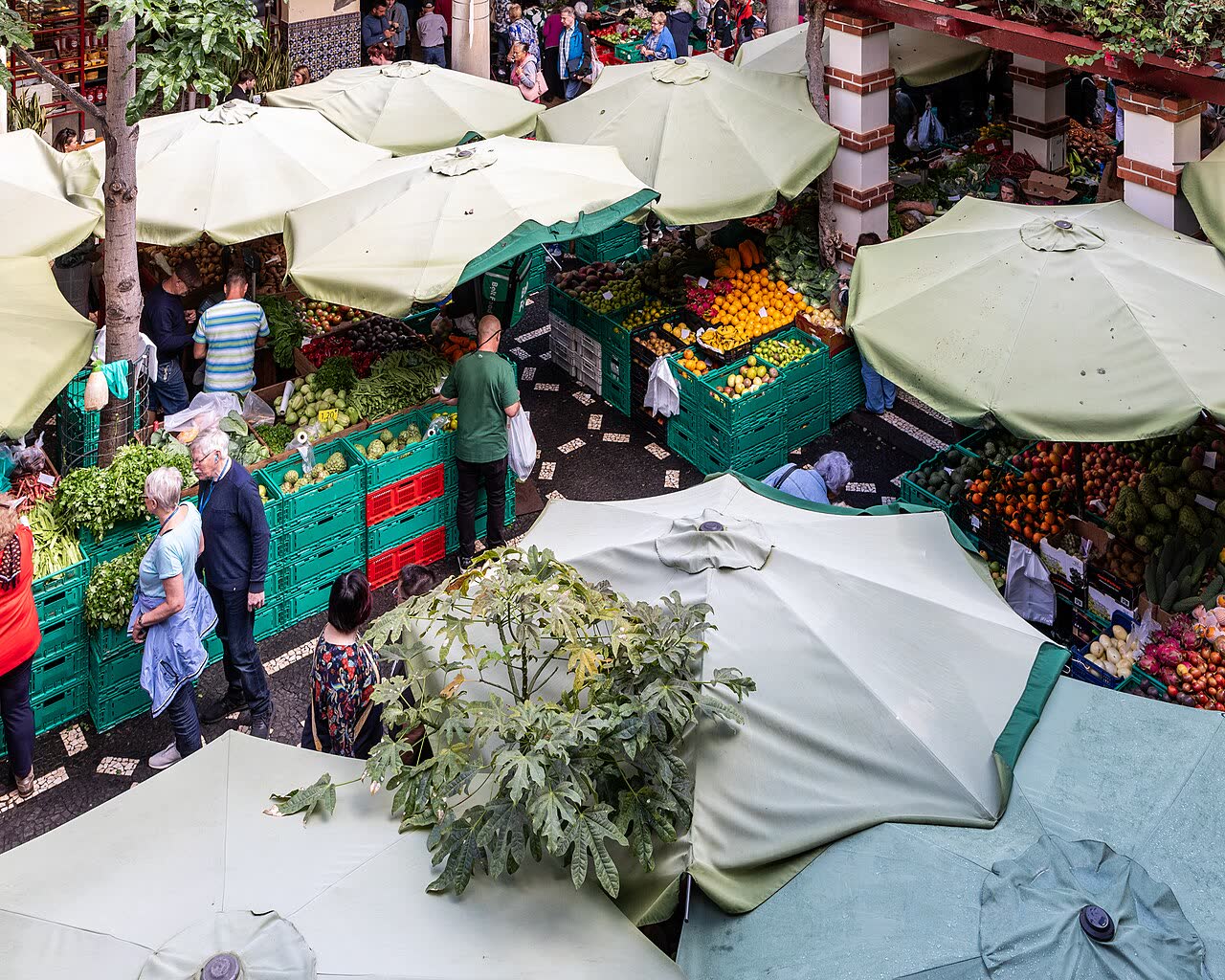
The open central courtyard and the gallery above are lined with stalls of small Madeira bananas, mangoes, custard apples and several kinds of passion fruit, plus vegetables, spices and sweets. This is where to watch the prices.
The fish market
Down the steps at the back is the tiled fish hall. The star is espada, black scabbardfish: long, black and eel-like, with huge eyes and fearsome teeth, caught on long lines in very deep water. On menus it usually comes as fillets with fried banana. In season you’ll also see whole tuna cut into steaks. Go before about 11am and wear shoes with grip.
Upstairs: crafts and cafés
The upper gallery adds souvenir and craft shops, with wicker and embroidery, and a couple of small café-bars overlooking the courtyard.
The fruit price problem
The usual pattern: a friendly seller cuts you a free taste of something exotic, bags up a selection, and you only learn the price per kilo at the till. Portuguese papers have reported fruit at close to €50 a kilo (2023), and in October 2025 a video of tourists paying €72 for a handful of fruit went viral. More complaints followed in September 2026.
In 2021 the council opened an inquiry into three fruit stalls after a German TV programme filmed the practice. On 15 May 2026 the regional consumer authority, ARAE, inspected 30 stalls and shops. It found four breaches linked to the complaints book but none on weights or price information, and reminded traders that prices are free but must be clearly displayed. In short, high prices are legal; hidden ones are not.
- Ask first: before tasting, ask quanto custa o quilo? (how much per kilo?) and look for the label.
- Be specific: ask for one or two pieces, not “a selection”, and watch it being weighed.
- Get the total before it’s bagged: if it’s too much, say não, obrigado (no, thank you).
- Complaints: every trader must keep a Livro de Reclamações (complaints book), and you can ask for it.
Exotic fruits to try
- Anona: Madeira’s custard apple, a local cherimoya with EU protected status since 2000. Spoon out the creamy flesh and leave the black seeds.
- Maracujá: passion fruit comes in several varieties, often labelled by flavour, such as banana passion fruit (long and yellow) and pineapple passion fruit.
- Tamarillo: the tangy, egg-shaped “tree tomato”. Halve it and scoop out the flesh; the skin is bitter.
- Monstera deliciosa: the scaly green cob of the Swiss cheese plant, with a flavour often compared to banana and pineapple. It ripens from the bottom up, so only eat the parts where the scales have fallen off: unripe flesh contains needle-like crystals that irritate the mouth and throat.
When to go
Go in the morning. Friday is traditionally the liveliest day, when growers come in from around the island; Saturday is busy too but closes at 2pm. Arrive by about 9am to beat the cruise groups. On 23 December, the Noite do Mercado fills the market and nearby streets with stalls, poncha and carols. See Madeira in winter.
Getting there and paying
- On foot: about 5 to 10 minutes east of the cathedral, or about 25 minutes along the seafront from the cruise pier.
- By bus: yellow city buses stop nearby. Every Madeira route was renumbered with three digits on 9 March 2026, so ignore older numbers. See getting around Madeira.
- Paying: carry some cash in small notes, and ask whether a stall takes cards before anything is weighed.
- With children: the fish hall is usually the hit. See Madeira with kids.
Book ahead: you don’t need a ticket or guide, as the market is free to wander on your own. If you’d like help with the fruit and fish, a food tour adds a guide and tastings; check that it includes the market. See Funchal food tours.
What’s nearby
- Rua de Santa Maria: Funchal’s oldest street runs east from the market, with around 200 painted doors. See Funchal Old Town.
- Monte cable car: the lower station by the Almirante Reis gardens is a few minutes away; about €16 one way or €22 return in 2026. See the Monte toboggan.
- Fort of São Tiago: the yellow fort at the end of the Old Town, with the Barreirinha swimming area beyond. See the best beaches in Madeira.
- Blandy’s Wine Lodge: about 10 to 15 minutes west on Avenida Arriaga. See the Madeira wine guide.
For lunch, the Old Town lanes are full of restaurants and poncha bars serving espetada, espada and bolo do caco (garlic flatbread). Places change often, so check recent reviews.
FAQ
What are the Mercado dos Lavradores opening hours?
Monday to Friday 7am to 7pm and Saturday 7am to 2pm. It’s closed on Sundays and public holidays.
Is the Mercado dos Lavradores a tourist trap?
Not the market itself: the building, flowers and fish hall are free and worth seeing. Some fruit stalls charge very high prices per kilo, so ask before you taste or buy.
What is the best day to visit?
Friday morning is traditionally the busiest and most colourful. Saturday morning is lively too, but the market closes at 2pm.
What fruit should you try in Madeira?
Anona (custard apple), the different passion fruits and tamarillo. Eat monstera only where the scales have fallen off.
More: things to do in Funchal and Madeira on a budget.
See also: the Madeira travel guide, Porto’s Bolhão Market and Lisbon’s food markets.
Some links in this guide are affiliate or referral links (GetYourGuide, Booking.com, Discover Cars, Welcome Pickups, Airalo, Yesim, Saily, Tiqets, Radical Storage, EKTA, AirHelp, Uber). If you book or sign up through them we may earn a small commission or ride credit at no extra cost to you. It helps keep our groups and this site free.
Still got questions?
Ask 305,000+ travellers and locals in our free Facebook groups.