
Trip guides / Planning
A Quick History of Portugal for Travellers
You’ll enjoy Portugal more with a little history: why there’s a castle on every hill, why the monuments are covered in ropes and sea creatures, and why Lisbon’s centre is laid out in a grid. Here’s a quick history of Portugal for travellers, with the places where you can see each chapter.
Quick answer: Romans and Moors left their mark; Portugal became a kingdom in the 12th century (born, legend says, in Guimarães); its sailors led the Age of Discoveries in the 15th and 16th centuries (see Belém); the 1755 earthquake destroyed Lisbon; a long dictatorship ended in the peaceful Carnation Revolution of 1974; and Portugal joined the EU in 1986.
Romans and Moors
The Romans ruled for centuries, building roads, bridges and temples. Then, from 711, the Moors of North Africa ruled much of Portugal for over 400 years, leaving castles, irrigation, place names (anything starting “Al-”, like Algarve and Alfama) and a love of tiles and almonds. See it: Évora’s Roman temple, Silves castle, Sintra’s Moorish Castle. See Évora and Silves.
The birth of Portugal
Afonso Henriques declared himself king in the 12th century, and Portugal was recognised as a kingdom in 1143. Christian armies pushed south, taking Lisbon in 1147 and the Algarve by 1249, making Portugal’s borders some of the oldest in Europe. See it: Guimarães castle, Lisbon’s São Jorge Castle, Tomar’s Templar convent. See Guimarães and Tomar.
The Age of Discoveries
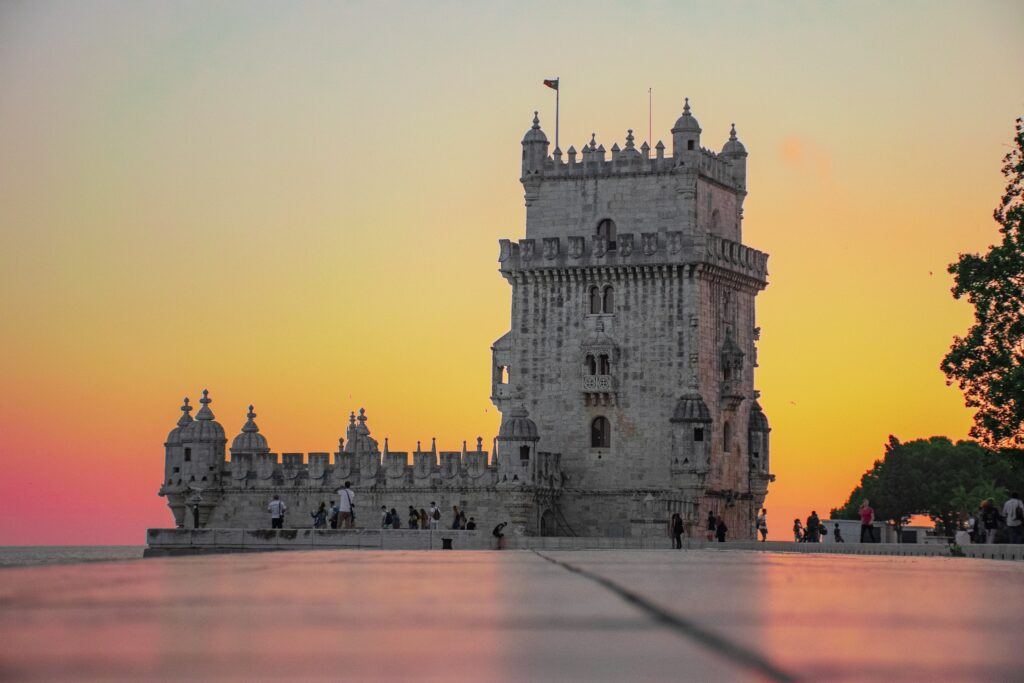
In the 15th and 16th centuries, Portuguese navigators explored the African coast, reached India by sea (Vasco da Gama, 1498) and Brazil (Pedro Álvares Cabral, 1500), building a global trading empire. The wealth paid for the ornate Manueline style, carved with ropes, anchors and sea creatures. See it: Jerónimos Monastery and Belém Tower in Lisbon, Tomar’s Manueline window, Sagres. See Sagres.
Spanish rule and restoration
From 1580 to 1640, Portugal was ruled by the Spanish crown, until a revolt restored independence. Gold from Brazil later funded lavish baroque churches. See it: the gilded churches of Porto and Lisbon, Mafra Palace. See Mafra.
The 1755 earthquake
On All Saints’ Day 1755, a huge earthquake, tsunami and fires destroyed much of Lisbon. The Marquis of Pombal rebuilt the Baixa on a grid with some of the first earthquake-resistant buildings in Europe. See it: the Baixa, Praça do Comércio, the ruined Carmo Convent. See things to do in Lisbon.
Monarchy to republic
Napoleon’s invasions sent the royal family to Brazil in 1807. In the 19th century, romantic palaces like Pena were built in Sintra. The monarchy fell in 1910. See it: Pena Palace and Sintra. See visiting Sintra.
Dictatorship and the Carnation Revolution
From 1933, Portugal lived under the Estado Novo dictatorship of Salazar. On 25 April 1974, a largely peaceful military coup, the Carnation Revolution, restored democracy. Soldiers put carnations in their rifles, and the date is a national holiday. Portugal’s African colonies became independent soon after, and Portugal joined the EU in 1986. See it: the 25 de Abril bridge (once named after Salazar), Largo do Carmo.
Modern Portugal
Expo ’98 transformed Lisbon’s riverside (see Parque das Nações), tourism boomed, and today Portugal is one of Europe’s most loved destinations.
More: the 25 best things to do in Portugal and the historic villages.
Prices and details change, so please double-check before you travel. Spotted something out of date? Tell us in the groups.
Still got questions?
Ask 305,000+ travellers and locals in our free Facebook groups.