
Trip guides / Central Portugal
The Schist Villages of Portugal: Talasnal, Lousa and More
The Schist Villages are clusters of dark stone houses in the mountains and river valleys of central Portugal. Several were almost empty by the 1980s, and many have since been restored. Come for quiet walks, cold river pools and long mountain lunches, starting about an hour from Coimbra.
Quick answer: the Aldeias do Xisto network links 27 villages in central Portugal. Start in the Serra da Lousã, where Talasnal, Candal and Cerdeira are about an hour from Coimbra, then add Piódão. You need a car, good shoes and 2 to 3 days.
.jpg)
What the Aldeias do Xisto network is
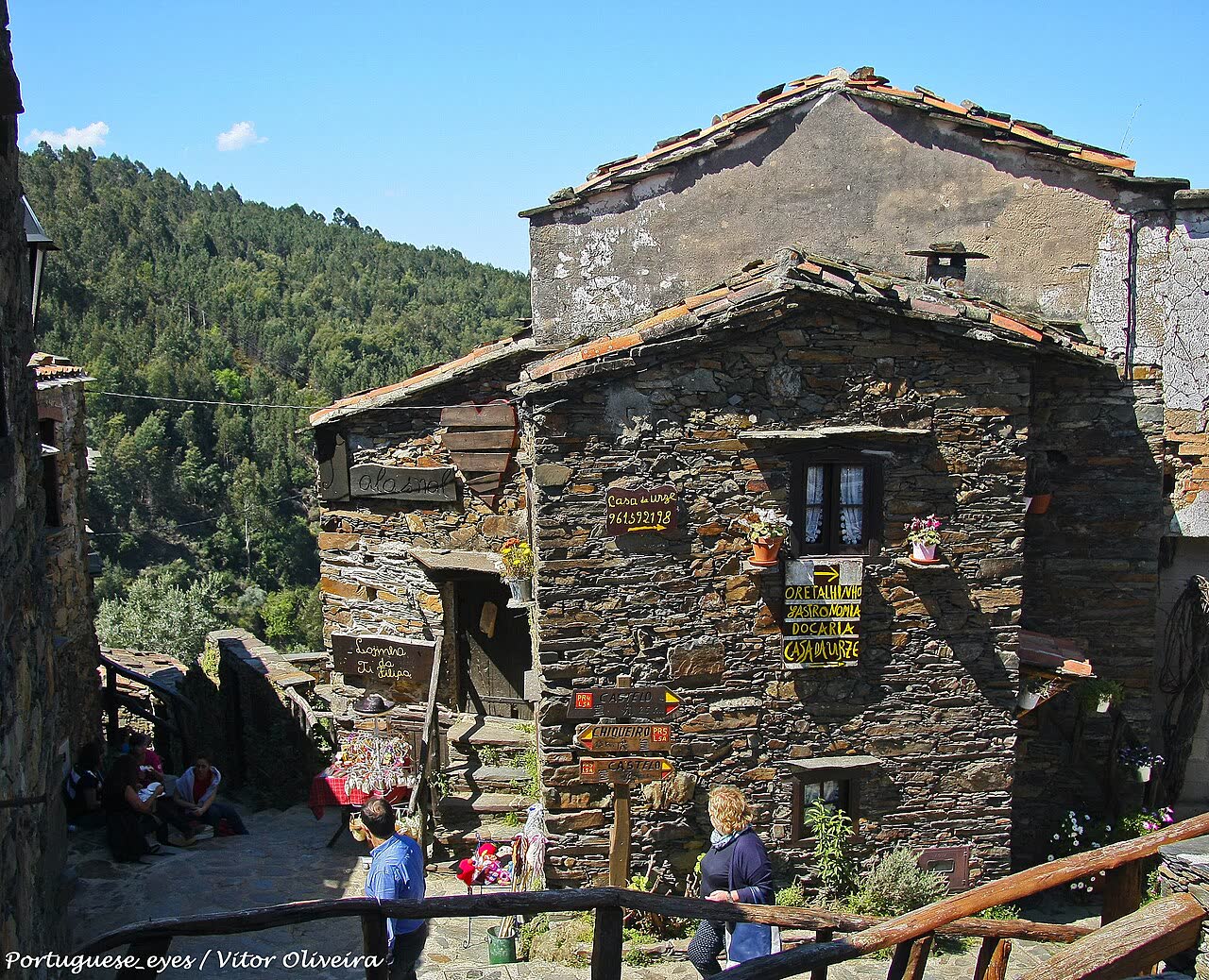
Schist (xisto) is the dark, layered stone of these hills. People split it into slabs for walls and roofs, so the houses match the slopes around them. The network began in 2001 as an EU-backed development programme for inland central Portugal, and a tourism agency, ADXTUR, now runs it.
The villages fall into four areas: the Serra da Lousã, the Serra do Açor, the Zêzere valley and Tejo-Ocreza. Most sources say 27 villages, 12 of them in the Serra da Lousã. The official site now lists 28, with Coentral Grande, a granite village in Castanheira de Pêra, added to the Lousã group. People still live in many of them, so keep your voice down in the lanes.
The Lousã mountain villages
Five schist villages sit on the western slopes of the Serra da Lousã, above the small town of Lousã. They are the easiest to visit from Coimbra.
- Talasnal: the largest and best known, on a steep hillside about 12 km by road from Lousã. It had 129 people in 1911 and just two by 1981. Many houses are now guesthouses. Try talasnicos, small honey and chestnut cakes created here.
- Chiqueiro and Casal Novo: two tiny hamlets near Talasnal, on narrow forest roads, some unpaved. Casal Novo’s old threshing floor looks down to Lousã castle.
- Candal: right beside the EN236 road, about 10 km from Lousã, so it’s the easiest to reach. Houses step down a steep valley past old water mills.
- Cerdeira: a little further along the same road. A German artist moved here in 1988 and began rebuilding the houses, and it’s now a crafts school and art centre with rural cottages.
The castle and the river beach
Below the villages, Lousã castle (Castelo de Arouce) dates from the second half of the 11th century, when it guarded the approaches to Coimbra. Beside it are the chapels of the Senhora da Piedade shrine and the river pools of the Praia Fluvial da Senhora da Piedade.
Walking between the villages
- PR2 LSA, Rota das Aldeias do Xisto: a 5.7 km loop from the castle up to Talasnal, Chiqueiro and Casal Novo, then down past the river beach. It climbs over 600 metres, so allow about 3.5 hours.
- PR3 LSA, Rota da Levada: a harder 10.8 km loop from Candal along an old irrigation channel to Talasnal and back, with nearly 1,000 metres of climbing. Allow about 5 hours.
Piódão
Piódão, in the Serra do Açor, is Portugal’s most famous schist village, with blue doors on terraces of dark stone. Officially it isn’t in the Aldeias do Xisto network but in the Historic Villages of Portugal. It’s 1.5 to 2 hours from Coimbra, so most people stay a night. See our Piódão guide.
Other villages worth the drive
- Fajão (Pampilhosa da Serra): the seat of its own small municipality until 1855. Nearby, the Penedos de Fajão are quartzite crags of almost 900 metres.
- Janeiro de Cima (Fundão): a village on the Zêzere whose walls mix schist with round white river pebbles. The Casa das Tecedeiras keeps linen weaving alive.
- Barroca (Fundão): also on the Zêzere, with an 18th-century manor house, old mills, a river beach and a stop on the GR33 trail.
- Água Formosa (Vila de Rei): a tiny hamlet between two streams, with old mills and the spring that gives it its name.
- Ferraria de São João (Penela): a quartzite village among cork oak woods, with a marked walk and mountain bike trails.
River beaches and swimming
There are more than 50 river beaches (praias fluviais) in the area, from dammed pools to rock pools on mountain streams. Easy picks are Senhora da Piedade below Lousã castle, Foz d’Égua near Piódão, and Barroca on the Zêzere. The water is very cold, even in August. Lifeguard seasons are short, usually around July and August, and set beach by beach.
Walks
The network’s short marked trails, the Caminhos do Xisto, follow old paths once used by millers, farmers and shepherds. For something longer, the GR33 Grande Rota do Zêzere runs about 370 km from the river’s source in the Serra da Estrela to Constância, on the Tagus. You can walk, cycle or paddle it in sections.
Paths are steep and slippery after rain. Carry water and download a map, as mobile signal is patchy in the valleys. See hiking in Portugal.
After the 2025 fires
In August 2025 a fire that started near Piódão burned about 64,000 hectares, though the village itself was spared. A day later another fire broke out above Candal, and the Lousã schist villages were evacuated as a precaution. Ask locally whether a trail is open, and check the fire risk in hot, dry weather.
Food
- Chanfana: goat slow-cooked in red wine in a black clay pot, traditionally in a wood oven. Miranda do Corvo and Vila Nova de Poiares both claim it.
- Cabrito: roast kid, usually with potatoes.
- Mel: Mel da Serra da Lousã is a dark, strong heather honey with EU protected status.
- Also try: chestnuts in autumn, sausages and corn bread (broa).
Choice in the villages is small, so check opening days out of season.
Getting there and around
- A car is essential: buses barely reach the villages. See driving in Portugal.
- Coimbra as a base: Lousã is about 40 minutes by car from Coimbra, and fast trains stop at Coimbra-B. See Coimbra.
- Without a car: the Metrobus runs from Coimbra to Lousã. From town you can walk to the castle and the PR2 loop, but not much further.
- Mountain roads: narrow, steep and twisting. Drive in daylight and fill up before you head into the hills.
- Winter: expect rain, fog and cold, with ice or the odd snowfall on the highest roads. Spring and autumn are best for walking.
A 2 to 3 day route
- Day 1: drive from Coimbra to Lousã castle, walk the PR2 loop, then swim at Senhora da Piedade. Sleep in Talasnal.
- Day 2: see Candal and Cerdeira, then drive east to Piódão for the evening light and stay the night.
- Day 3: walk to Foz d’Égua early, then head south via Fajão to Janeiro de Cima and Barroca on the Zêzere. Return to Coimbra or carry on to the Serra da Estrela.
With two days, stop after day 2.
Where to stay
Sleep in a restored schist cottage if you can. Talasnal, Cerdeira and Piódão all have rural guesthouses, but rooms are few, so book ahead for summer weekends. For more choice and restaurants, stay in Coimbra and do day trips. See where to stay in Coimbra.
Basing yourself in Coimbra? See places to stay in Coimbra, then drive out to Lousã in about 40 minutes.
FAQ
How many Schist Villages are there?
Usually 27, in four areas of central Portugal, though the official site now lists 28.
Is Piódão one of the Schist Villages?
It’s built of schist, but officially it belongs to the Historic Villages of Portugal.
Which schist village should I see if I only have a day?
Talasnal. Walk the PR2 loop from Lousã castle, which links it with Chiqueiro and Casal Novo in about 3.5 hours.
Can you swim at the river beaches?
Yes, at more than 50 river beaches, with lifeguards usually around July and August. The water is cold, even in summer.
More: Portugal’s lesser-known places, the most beautiful small towns and our Portugal road trip.
See also: Piódão, the Historic Villages, Coimbra, where to stay in Coimbra and Serra da Estrela.
Some links in this guide are affiliate or referral links (GetYourGuide, Booking.com, Discover Cars, Welcome Pickups, Airalo, Yesim, Saily, Tiqets, Radical Storage, EKTA, AirHelp, Uber). If you book or sign up through them we may earn a small commission or ride credit at no extra cost to you. It helps keep our groups and this site free.
Still got questions?
Ask 305,000+ travellers and locals in our free Facebook groups.