
Trip guides / Sintra and Cascais
Boca do Inferno, Cascais: How to Visit and What to See
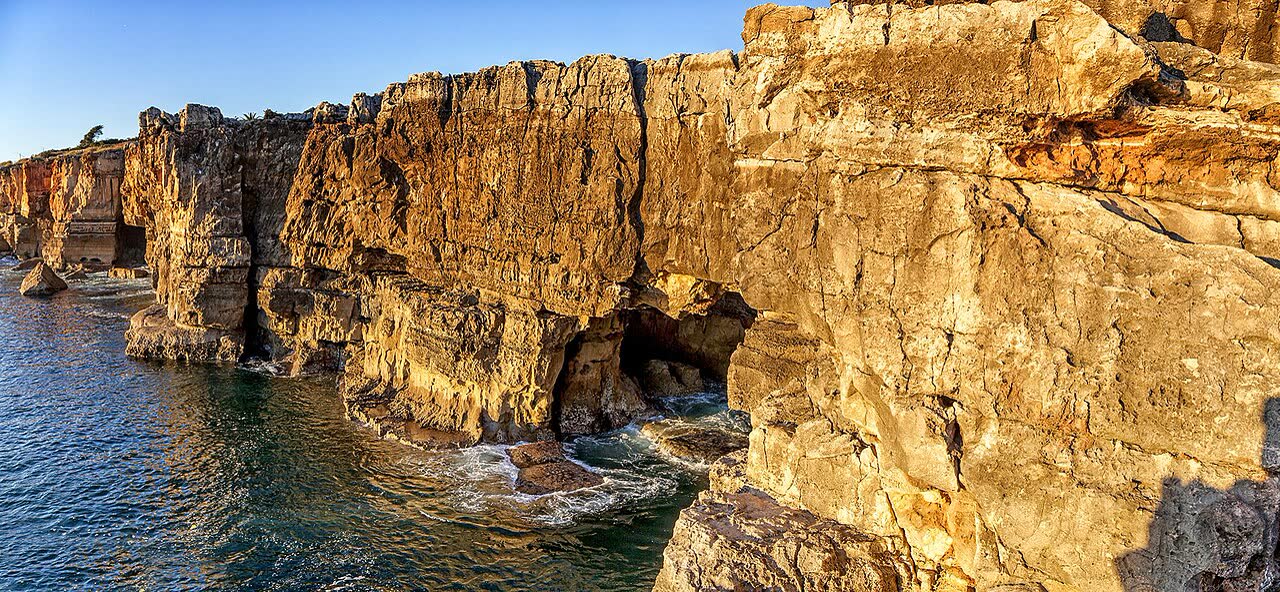
Boca do Inferno, “Hell’s Mouth”, is a chasm in the cliffs west of Cascais where Atlantic waves smash into the rock and surge under a natural arch. It’s free, always open and an easy walk from town.
Quick answer: walk about 2km (20 to 25 minutes) west from Cascais station along the seafront, or cycle the coastal path. Entry is free. Go when the sea is rough, ideally near high tide: on a calm day it’s just a rocky inlet. Allow 20 to 30 minutes, and stay behind the railings.

What is Boca do Inferno?
Boca do Inferno was most likely a limestone sea cave whose roof collapsed, leaving a deep hollow open to the sky, a rock arch over the water and a funnel that throws spray high in big waves. A British film of it, shot in 1896, is often called the first moving picture of a cave.
What you see
A short paved path leads from the coast road to railed viewing platforms on the clifftop. You look down into the chasm and across to the arch, where the swell rushes through and booms against the walls.
When to go: rough seas beat calm days
When the sea is flat, Boca do Inferno is a pretty but underwhelming cove. The show depends on the swell:
- Season: autumn and winter bring the biggest Atlantic swells. In summer the sea here is often calm.
- Swell: a big westerly or south-westerly swell works best. A rough-sea warning from IPMA, Portugal’s weather service, usually means a spectacular (and dangerous) day.
- Tide and light: go within a couple of hours of high tide. In autumn and winter the sun sets over the open sea.
The Aleister Crowley story
In September 1930 the English occultist Aleister Crowley came to Lisbon to meet the poet Fernando Pessoa. On 23 September Crowley vanished, and a farewell note hinting at suicide was found here. Pessoa helped stage the hoax, and the mystery filled the Portuguese papers. A few weeks later Crowley turned up alive in Berlin, at the opening of an exhibition of his paintings. Pessoa began a detective novel about it, O Mistério da Boca do Inferno, but never finished it.
Stay safe
- Stay behind the railings: the rocks are slippery, and one big wave can sweep a dry-looking ledge. People have died here, tourists have fallen in taking selfies, and in April 2026 a man was airlifted off the rocks after a fall.
- Children: never let them climb the barriers.
- No swimming: it isn’t a beach. See the best beaches near Cascais.
Food nearby
Beside the chasm, Mar do Inferno has served fresh fish and shellfish for around 50 years under the same family. It’s usually open 12:30pm to 10:30pm, closed Wednesdays. Shellfish is often priced by weight, so ask first.
Getting there
- From Lisbon: trains from Cais do Sodré take about 40 minutes, roughly every 20 minutes. In 2026, replacement buses run between Caxias and Cascais on many evenings, so check cp.pt before a late return.
- Walk: from the station, pass the marina and the Cidadela, then follow the seafront road west past the Santa Marta lighthouse. It’s mostly flat.
- Cycle: the coastal cycle path passes Boca do Inferno on its way to Guincho, about 7km further on. The MobiCascais kiosk by the station rents classic biCas bikes, at the last published rates about €2 an hour or €6 a day. Shared Bird e-bikes are paid in the Bird app (free only for local Viver Cascais cardholders). See cycling in Portugal.
- Bus: MobiCascais line M27, a circular from Cascais station, stops at Boca do Inferno. A day ticket costs €1.50 in the MobiCascais app or €2 on board (2026). Check times in the app.
- Car: there’s roadside parking on the coast road (Avenida Rei Humberto II de Itália), but it fills up on sunny weekends. Check the signs, as much of Cascais has paid parking.
Combine it with
- The museums quarter: you pass the Santa Marta lighthouse museum and the Condes de Castro Guimarães museum on the way. Municipal museums cost about €5 each or €7.50 for a day pass, free for under-18s. The Casa de Santa Maria, Raul Lino’s 1902 house, is temporarily closed for renovation.
- Guincho: cycle on, or take MobiCascais bus M05 or M15 from Cascais station. See Guincho beach.
- Cabo da Roca: about 20 minutes’ drive, or Carris Metropolitana bus 1624 from Cascais. The clifftop is free; the lighthouse visit costs from about €5. See the Cabo da Roca guide.
- Sunset: stay on the clifftop, or head on to Guincho. See the best sunset spots.
- Sintra: loop by train to Sintra, bus 1624 to Cascais and the train back. See Sintra and Cascais in one day and Lisbon to Sintra.
Staying over? Browse places to stay in Cascais, and budget for the €4 per night tourist tax (up to seven nights).
FAQ
Is Boca do Inferno worth visiting?
Yes, if the sea is rough: it’s free, close to town and dramatic. On a calm day it’s a nice walk, not a must-see.
How long is the walk from Cascais to Boca do Inferno?
About 20 to 25 minutes (2km) from the train station along the seafront, a little less from the old town.
When is the best time to see Boca do Inferno?
A big-swell day near high tide, most often in autumn or winter.
Do you have to pay to see Boca do Inferno?
No. It’s an open-air site with no ticket or opening hours. Take extra care after dark.
More: the Cascais day trip and Sintra vs Cascais.
See also: things to do in Cascais, where to stay in Cascais and the best beaches near Cascais.
Some links in this guide are affiliate or referral links (GetYourGuide, Booking.com, Discover Cars, Welcome Pickups, Airalo, Yesim, Saily, Tiqets, Radical Storage, EKTA, AirHelp, Uber). If you book or sign up through them we may earn a small commission or ride credit at no extra cost to you. It helps keep our groups and this site free.
Still got questions?
Ask 305,000+ travellers and locals in our free Facebook groups.