
Trip guides / Lisbon
Feira da Ladra: Lisbon's Flea Market Guide
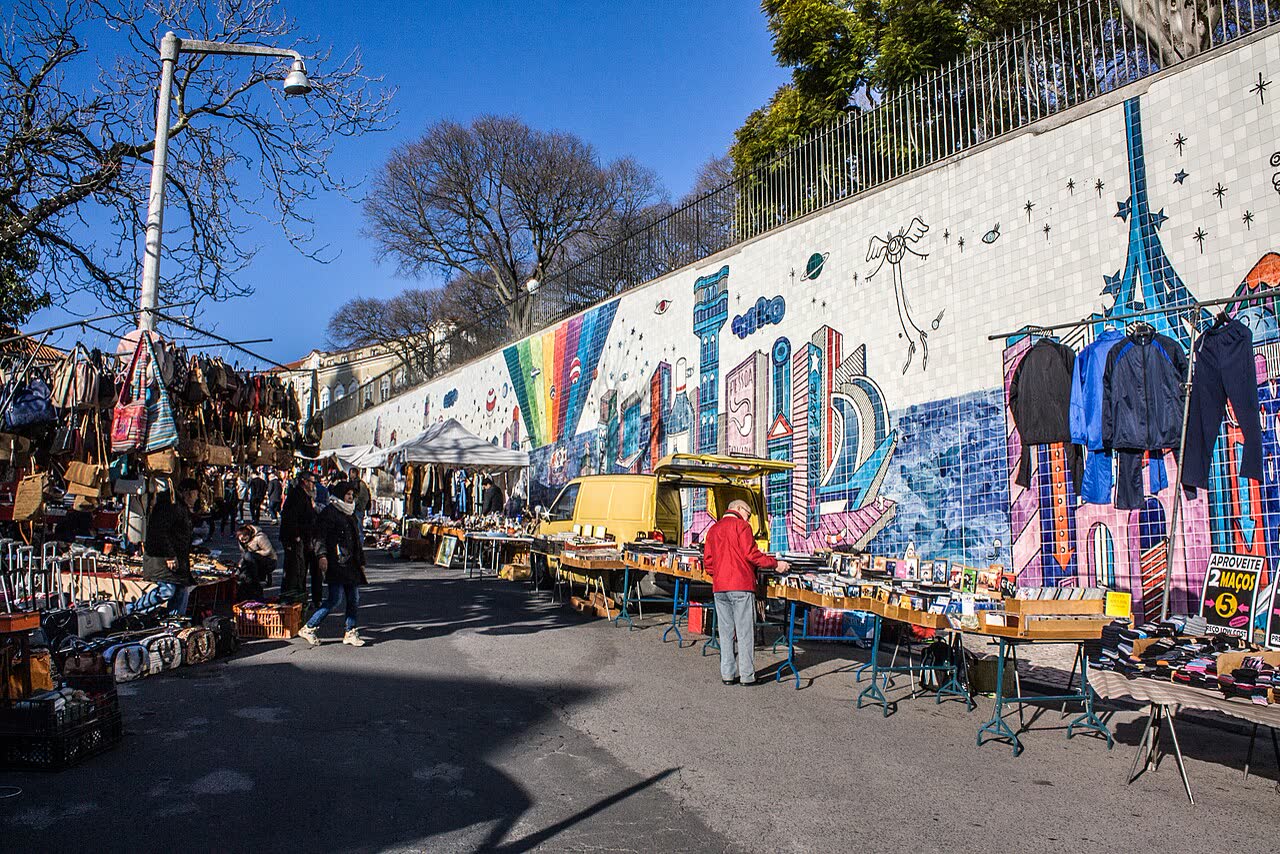
The Feira da Ladra is Lisbon’s oldest market and its best-known flea market. Twice a week, sellers spread old tiles, records, books, clothes and plenty of junk across a square behind the São Vicente de Fora monastery. It’s free to browse, fun even if you buy nothing, and an easy add-on to a morning in Alfama or Graça.
Quick answer: the market runs every Tuesday and Saturday on Campo de Santa Clara, officially from 9am to 6pm. Go in the morning, as many stalls pack up from early afternoon. Bring cash in small notes, haggle politely, watch your bag, and avoid antique tiles with no clear history. Get there by bus 734, tram 28 or on foot from Alfama.
.jpg)
When and where
The market fills Campo de Santa Clara, a long square on the eastern edge of Alfama, between São Vicente de Fora and the National Pantheon. Lisbon’s tourist board lists it every Tuesday and Saturday from 9am to 6pm, and entry is free.
The best of it is over long before 6pm. Many sellers pack up from early afternoon, so arrive by mid-morning, when the choice is widest. Saturday is busier and livelier. Tuesday is quieter, with more room to browse.
A short history
This is the oldest known market in Lisbon to have run more or less continuously. Records of a market below the castle go back to 1272. It then moved around the city, to the Rossio, Praça da Alegria and Campo de Santana, before settling on Campo de Santa Clara in 1882. At first it was held only on Tuesdays, and Saturdays were added in 1903.
The name means “the thieves’ market” and first appears in an official document in 1610. Nobody is sure why. One theory is that stolen goods were sold here. Others link it to ladro, an old word for lice in second-hand goods, or to lada, an old Portuguese word for a riverbank.
What you can buy
- Azulejo tiles: loose old tiles turn up on many stalls, but be careful. Tile theft from old buildings has been a real problem in Portugal, stolen tiles have surfaced at markets, and the police launched the SOS Azulejo project in 2007 to fight it. Only buy an antique tile if the seller can tell you where it came from. A new hand-painted tile is a safer souvenir: see azulejos.
- Vinyl and books: crates of fado and old Portuguese LPs, plus second-hand books and comics, mostly in Portuguese.
- Vintage clothes: jackets, linens and embroidery. Check seams and zips before you pay.
- Ceramics: plates, jugs and glasses, from everyday pieces to older painted pottery.
- Curiosities and junk: postcards, coins, stamps, military medals, religious figures, old chargers and odd shoes. Half the fun is looking.
What’s a fair price? There are no fixed prices, and a dealer with a proper stall will ask more than someone selling from a tarpaulin on the ground. Walk round once before you buy so you can compare. A fair price is roughly what similar things cost at the next few stalls. For rare records or real antiques, check prices online first.
Haggling and paying
- Cash: most sellers want cash, so bring coins and small notes. Use a bank (Multibanco) ATM before you arrive, not a Euronet machine. See money in Portugal.
- Bargain politely: haggling is normal, especially for bigger items or several things at once. Ask the price, offer a bit less with a smile, and meet in the middle. Quanto custa? means “how much is it?”
- Don’t overdo it: skip haggling over the cheapest things, and don’t make an offer you won’t pay.
Staying safe
The market is safe, but crowds draw pickpockets, especially on Saturday mornings and on tram 28 on the way there. Wear your bag in front and zipped, keep your phone out of back pockets, and don’t flash a roll of notes. The cobbles are uneven, so wear comfortable shoes. See is Lisbon safe?
Getting there
- Bus 734: runs between Martim Moniz and Santa Apólonia station via Graça, with stops on Campo de Santa Clara itself.
- Tram 28: get off at Voz do Operário, just past Graça, and walk a few minutes downhill. It’s packed on Saturdays, so board early at Martim Moniz. It has run the full route again since late September 2026, but check Carris for service changes. See the trams guide.
- Metro: Santa Apólonia (blue line), then a short but steep walk uphill.
- On foot: about ten minutes east of the Portas do Sol viewpoint in Alfama.
What to see nearby
- São Vicente de Fora: a monastery with tiled cloisters, the tombs of the Braganza kings and rooftop views. Open daily, usually from 10am to 6pm. Allow about an hour. See Lisbon’s churches.
- The National Pantheon: the white-domed church of Santa Engrácia, begun in 1682 and only finished in 1966. The fado singer Amália Rodrigues is buried here, and the dome terrace has river views. About €10, closed on Mondays, so it’s open on both market days.
- Mercado de Santa Clara: the market hall on the square, opened in 1877 and one of Portugal’s first iron-and-glass buildings. It has since hosted events such as record fairs.
- Graça’s viewpoints: walk uphill to the Miradouro da Graça and Senhora do Monte. To get down to Mouraria, the Graça funicular, reopened on 30 April 2026, costs about €4.30 for two trips bought on board. See Graça.
Other Lisbon markets
- LX Market: every Sunday at LX Factory in Alcântara, usually from late morning to early evening, with crafts, vintage clothes, records and food. See LX Factory.
- Mercado de Campo de Ourique: a 1934 market turned food hall, with fresh produce in the morning and food counters later. See Campo de Ourique.
- Feira do Relógio: a big Sunday street market near Bela Vista metro, usually from about 7am to 2pm, with cheap clothes and household goods rather than antiques.
FAQ
What days is the Feira da Ladra open?
Every Tuesday and Saturday on Campo de Santa Clara, officially from 9am to 6pm.
What time should I go?
In the morning. Many stalls start packing up from early afternoon, and Saturday crowds build through the late morning.
Can you pay by card?
Don’t count on it. Most sellers want cash, so bring coins and small notes.
Is it safe to buy old tiles there?
Only if the seller can tell you where they came from. Stolen tiles have turned up at markets, so skip cheap antique tiles with no clear history.
More: things to do in Lisbon, Lisbon on a budget and tile-painting workshops.
See also: Lisbon’s food markets, Graça, Alfama, Lisbon’s trams, souvenirs from Portugal, azulejos, LX Factory and free things to do in Lisbon.
Prices and details change, so please double-check before you travel. Spotted something out of date? Tell us in the groups.
Still got questions?
Ask 305,000+ travellers and locals in our free Facebook groups.