
The Best Beaches in the Azores (and Natural Pools)
The Azores are not a classic beach destination. These are young volcanic islands, so most beaches have dark sand, and many of the best swims are in natural lava pools with ladders into the sea. The Atlantic is also cooler than most people expect, and for pale sand you need to go to Santa Maria.
Quick answer: on São Miguel, swim at Pópulo and Milícias near Ponta Delgada, Água d’Alto or the Caloura pool, and surf at Santa Bárbara. For pale sand, fly to Santa Maria for Praia Formosa and São Lourenço. Elsewhere, try Porto Pim on Faial, Praia da Vitória and the Biscoitos pools on Terceira, and Pico’s lava pools. The sea is warmest in August and September, at about 22 to 24°C.
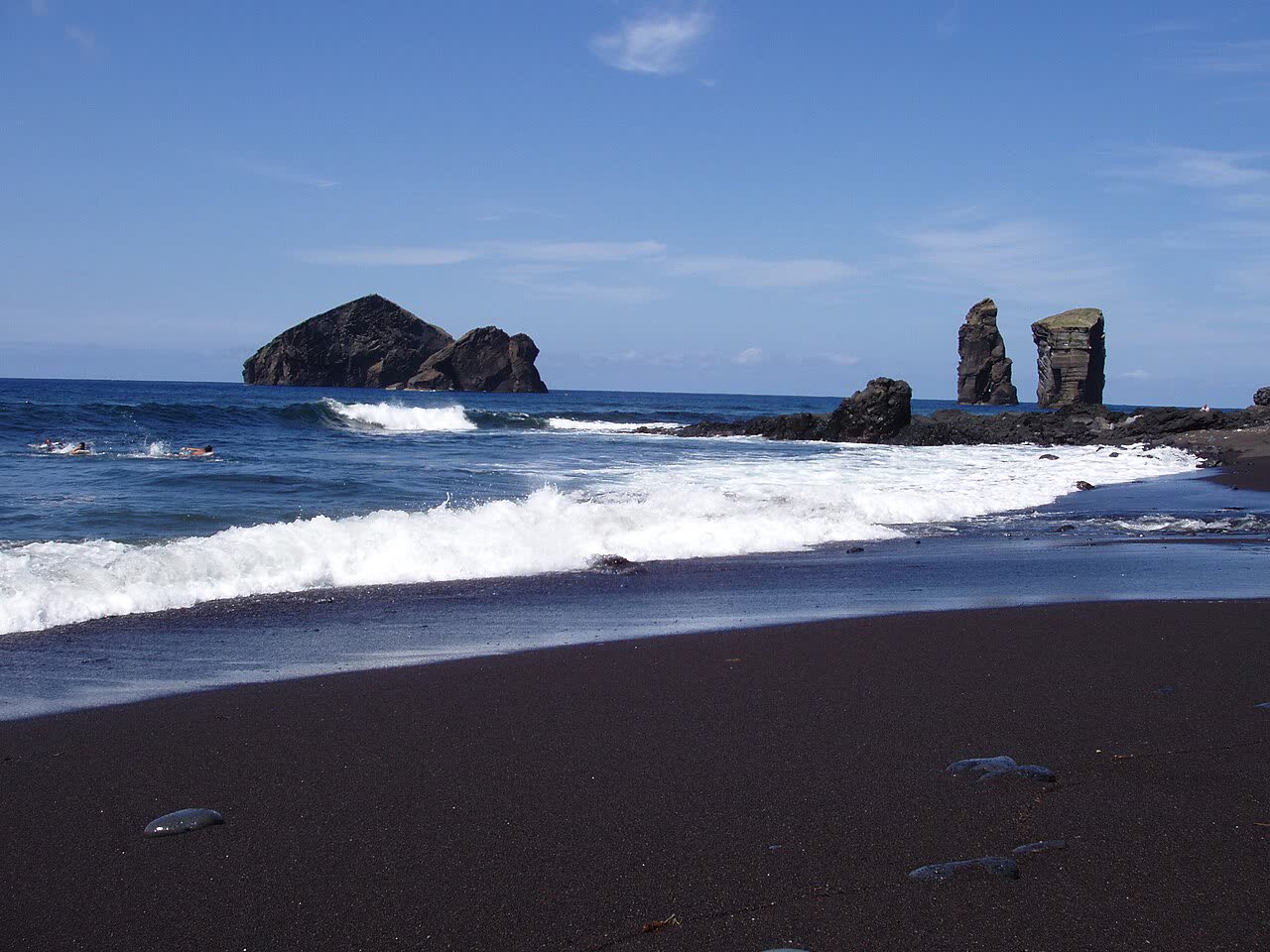

What to expect
Most beaches are short stretches of black or grey sand between lava headlands, open to the Atlantic swell. Where there’s no beach, villages have built bathing areas on the rocks, with paths, ladders and sea-filled pools. In 2026, 45 beaches and bathing areas in the Azores flew the Blue Flag.
The water is the big surprise. Long-term averages for Ponta Delgada are about 16 to 17°C from January to May, 19°C in June, 22°C in July and 23°C in August and September, with warm spells reaching about 24°C.
The beaches at a glance
| Beach | Island | Type | Best for |
|---|---|---|---|
| Santa Bárbara | São Miguel | Black sand | Surfing |
| Pópulo and Milícias | São Miguel | Dark sand | A swim near Ponta Delgada |
| Água d’Alto | São Miguel | Dark sand | A beach day |
| Caloura | São Miguel | Natural pool | Calm swimming |
| Mosteiros | São Miguel | Black sand, rock pools | Sunsets |
| Ponta da Ferraria | São Miguel | Hot spring in the sea | A warm dip |
| Praia Formosa | Santa Maria | Pale sand | Families |
| São Lourenço | Santa Maria | Pale sand | Scenery |
| Porto Pim | Faial | Sandy bay | Families |
| Almoxarife | Faial | Black sand | Views of Pico |
| Praia Grande | Terceira | Sandy bay | Windsurfing |
| Biscoitos | Terceira | Lava pools | Snorkelling |
| Lajes and Madalena | Pico | Lava pools | Volcano views |
| Fajã Grande | Flores | Rock pools | Wild scenery |
São Miguel
Santa Bárbara (Ribeira Grande)
The island’s best known surf beach is about a kilometre of black sand beside Ribeira Grande on the north coast, with surf schools on the sand for beginners. The same waves make swimming harder, so stay between the lifeguard flags. See surfing in Portugal.
Pópulo and Milícias (Ponta Delgada)
The nearest proper beaches to the city, about 4 to 5km east of the centre. Milícias is a wide stretch of dark sand. Pópulo, next door, is smaller, with little parking. See things to do in Ponta Delgada.
Água d’Alto and the Vila Franca islet
Just west of Vila Franca do Campo, Água d’Alto has roughly 560m of dark sand. It faces the open sea and the seabed can drop quickly, so check the flag. Offshore, the Ilhéu de Vila Franca is a flooded volcanic crater. It reopened to bathers in 2026 after closing in summer 2025 over water quality. Boats leave from the Vila Franca marina (about €10 return for visitors), and numbers are capped at 400 a day, so go early.
Caloura
Near Água de Pau, a natural pool built into the rocks sits beside a small, colourful fishing harbour, with ladders down to the open sea. Entry is free. It’s one of the island’s calmest swims, but it gets busy on summer weekends.
Mosteiros
At the island’s western tip, below Sete Cidades, this village has a black-sand beach facing rocky islets that rise straight out of the sea, and some of the best sunsets on São Miguel. Waves can be strong on the sand, so families often prefer the rock pools just to the south. Combine it with Sete Cidades.
Ponta da Ferraria
On the far west coast, a hot spring flows into a rocky sea inlet, where you swim holding on to ropes. It’s free and warmest around low tide, but stay out if waves break into the inlet. The road down reopened on 20 May 2026 after a landslide, and the old spa building has closed for good. The 2026 bathing list gave it lifeguards from 1 June to 30 September.
Poça da Dona Beija, Terra Nostra and Caldeira Velha are hot pools, not beaches. See the Azores hot springs.
Santa Maria: the sandy island
Santa Maria is the sunniest island and has the only pale sand in the Azores. There has been no passenger ferry from São Miguel since about 2021, so fly from Ponta Delgada in about 30 minutes. See Santa Maria.
- Praia Formosa: nearly a kilometre of pale sand on the south coast, with shallow, usually clear water. It hosts the Maré de Agosto music festival (19 to 22 August in 2026).
- São Lourenço: a sheltered bay on the east coast, ringed by vineyard terraces like an amphitheatre, with light sand and calm water.
Book ahead: Santa Maria has few places to stay, and rooms fill up around the August festival. See places to stay on Santa Maria.
Faial
Porto Pim is a curved sandy bay on the edge of Horta, about 350 to 400m long and sheltered by the Monte da Guia headland, with a gentle slope that suits children. About 5km from Horta, Almoxarife is a long black-sand beach facing Pico across the channel, with a campsite behind it. See Faial.
Terceira
The town of Praia da Vitória sits on a wide bay, and its main beach, Praia Grande, has the longest stretch of sand on the island, beside the marina. It’s popular for windsurfing. On the north coast, Biscoitos has pools formed where lava flows met the sea, with ladders, paths and very clear water. See Terceira.
Pico and Flores: lava pools
Pico has very little sand, but its coast is lined with lava pools with ladders and sun decks. Good ones include Lajes do Pico on the south coast, Cais do Mourato and Laja das Rosas near Madalena, and São Roque. None of Pico’s bathing areas was listed with lifeguards for 2026, so swim with care. See Pico.
On Flores, the bathing area at Fajã Grande, by the harbour on the west coast, has rock pools and a dark beach of sand and pebbles under huge cliffs. Its official season is only July and August, with no lifeguards listed in 2026, and it’s very exposed to the sea. See Flores.
Practical tips
- Lifeguards: in 2026 most lifeguarded beaches had cover from mid-June to mid-September, and a few, including Santa Bárbara and Almoxarife, from 1 June to 30 September. Outside the season, you swim at your own risk.
- Flags: green means swim, yellow means paddle but don’t swim, and red means stay out.
- Currents: exposed beaches such as Santa Bárbara and Mosteiros get big swell and strong currents. If in doubt, choose a sheltered pool.
- Water shoes: essential on lava rock and pebbles. Black sand also gets very hot in the sun.
- Sunscreen: a cool breeze and thin cloud make it easy to burn.
- Jellyfish: Portuguese man o’ war sometimes drift in with onshore winds. Never touch one, even dead on the sand.
- Best months: July to September, with September often the best mix of warm water and fewer people. See the best time to visit the Azores.
FAQ
Are there sandy beaches in the Azores?
Yes, but most have dark volcanic sand. São Miguel, Terceira and Faial all have sandy beaches, while Santa Maria has the only pale sand.
Is the sea warm in the Azores?
Not very. It’s about 16 to 17°C in spring and about 22 to 24°C in August and September.
What is the best beach on São Miguel?
Pópulo, Milícias or the Caloura pool for an easy swim, Santa Bárbara for surfing, and Mosteiros for sunsets.
Can you swim at Ponta da Ferraria?
Yes, on calm days, ideally around low tide. It’s free, the road reopened in May 2026 and the spa has closed for good.
More: the Azores travel guide and the São Miguel itinerary.
See also: the best beaches in Madeira, the Azores with kids, Azores island hopping and the best beaches in Portugal.
Some links in this guide are affiliate or referral links (GetYourGuide, Booking.com, Discover Cars, Welcome Pickups, Airalo, Yesim, Saily, Tiqets, Radical Storage, EKTA, AirHelp, Uber). If you book or sign up through them we may earn a small commission or ride credit at no extra cost to you. It helps keep our groups and this site free.
Still got questions?
Ask 305,000+ travellers and locals in our free Facebook groups.