
Trip guides / North Portugal
Guimaraes, Portugal: Things to Do in the Birthplace of Portugal
Guimarães is where Portugal began. Its first king, Afonso Henriques, won the battle that set him on the road to independence just outside town in 1128, and the walled old town below his castle is one of the best preserved in the country.
Quick answer: take the urban train from Porto São Bento (about 1h10 to 1h20, about €3.60). See the castle and the Palace of the Dukes of Bragança (€5 each, about €8 combined), walk down Rua de Santa Maria to Largo da Oliveira, and ride the cable car up Penha if it’s running. Half a day covers the main sights; stay a night if you can.

Why visit Guimarães
Afonso Henriques is traditionally said to have been born here, and on 24 June 1128 he beat his mother’s forces at the Battle of São Mamede. The historic centre became a UNESCO World Heritage Site in 2001, extended in 2023 to the Couros tanneries. Guimarães was European Capital of Culture in 2012 and is European Green Capital in 2026. See Portuguese history for travellers.
Things to do in Guimarães
The “Aqui nasceu Portugal” wall
Beside the Largo do Toural, the main square, giant letters on a tower of the medieval walls read “Aqui nasceu Portugal” (Portugal was born here). They’ve been there since the 1960s.
Guimarães Castle and São Miguel church
Countess Mumadona Dias built the first fortress here in the mid-10th century; its eight towers and tall keep date mostly from the late 13th century. Tickets cost €5. The wall-walk reopened in August 2024 after restoration, but the keep stayed closed during the works, so ask whether you can climb it. See castles in Portugal.
The little Romanesque church of São Miguel next door, consecrated in 1239, is free. Tradition says Afonso Henriques was baptised here, though historians doubt it.
Palace of the Dukes of Bragança
Built in the 15th century by Afonso, the first Duke of Bragança, the palace later fell into ruin and became a barracks, so today’s building, with its forest of brick chimneys, is largely a reconstruction from 1937 to 1959. Inside are grand halls and copies of the Pastrana tapestries, showing Portugal’s conquests of Arzila and Tangier.
Some rooms may be closed for restoration, and the ticket is €5 meanwhile. It’s open daily from 10am to 6pm (last entry 5:30pm), except 1 January, Easter Sunday, 1 May and 25 December; it has also closed on 24 June, the town holiday. See palaces in Portugal.
Largo da Oliveira and Praça de Santiago
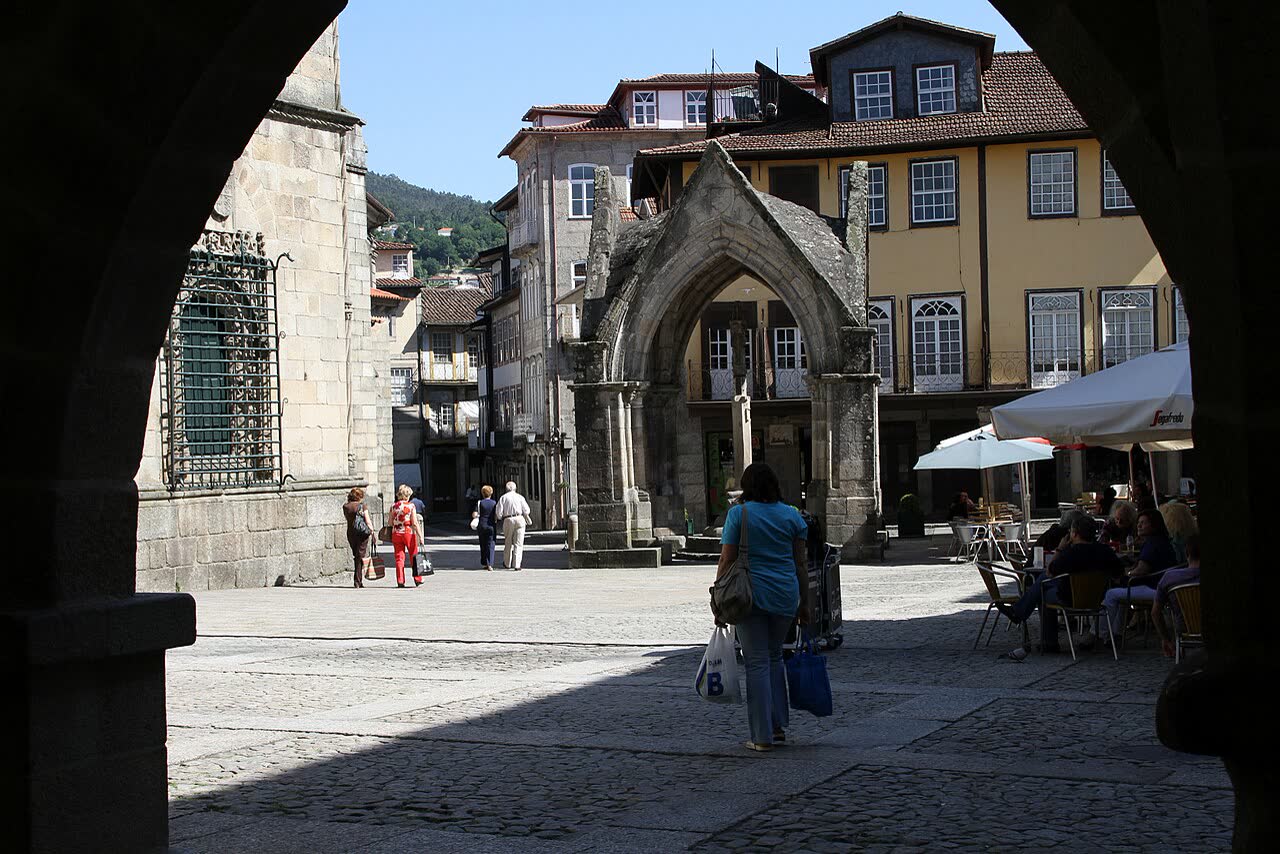
Joined by the arches of the old town hall, these squares are the heart of the old town. Largo da Oliveira has the church of Nossa Senhora da Oliveira and the Padrão do Salado, a Gothic shrine to the Battle of Salado in 1340. Praça de Santiago is lined with balconied medieval houses. Both fill with café tables in the evening.
Rua de Santa Maria
One of the oldest streets in town climbs from Largo da Oliveira towards the castle, past granite houses, coats of arms and the Convent of Santa Clara, now the town hall.
Alberto Sampaio Museum
Beside the Oliveira church, this museum holds the church’s treasures, including the tunic King João I wore at the Battle of Aljubarrota in 1385 and the Nativity triptych he gave in thanks for the victory. Tickets cost €5. It’s usually open Tuesday to Sunday, 10am to 6pm (later in July and August).
The Couros tanneries
The Couros zone, on the southern edge of the old town, was the tanning quarter for centuries; stone tanks and old factories still line the stream. One tannery is now Curtir Ciência, a small science centre (usually Monday to Saturday, guided visits). See UNESCO sites in Portugal.
Penha and the cable car
Penha, the wooded hill above town, rises to 617 metres, with trails, cafés, big views and a granite sanctuary opened in 1947. The cable car climbs about 1.7km from the Hortas station near the old town in around ten minutes. It closed for long maintenance in early 2026 and was running again by the autumn, usually daily from 10am, but it still stops for bad weather and maintenance days. The operator lists about €4 one way for adults in 2026; return prices quoted online vary, so check at the ticket office.
Tickets and opening hours
| Sight | Adult ticket (2026) | Usual hours |
|---|---|---|
| Palace of the Dukes | €5 (reduced during works) | Daily 10am–6pm |
| Castle | €5 | Daily 10am–6pm |
| Palace and castle | About €8 | – |
| Palace, castle and Alberto Sampaio | About €13 | – |
| Alberto Sampaio Museum | €5 | Tue–Sun |
| São Miguel church | Free | Daily 10am–6pm |
| Penha cable car | About €4 one way | About 10am–6:30pm |
A walking route through the old town
Allow three to four hours. Start at the Toural wall, detour to Couros, then visit Largo da Oliveira, the museum and Praça de Santiago. Climb Rua de Santa Maria to the palace and finish on the castle walls. Then ride up to Penha, or head back for dinner.
Getting there
From Porto by train
Urban trains from São Bento, calling at Campanhã, take about 1h10 to 1h20, and a single costs about €3.60 in 2026. Buy it at the station, as Andante doesn’t cover the trip. Trains run roughly hourly on weekdays and less often at weekends, so check the last train back. The station is 10 to 15 minutes’ walk from the Toural. See day trips from Porto by train.
Other ways
- Coach: under an hour from Porto, but rarely cheaper than the train.
- Porto airport: Getbus shuttles take about 50 minutes, for about €9.
- Lisbon: a couple of direct Intercidades trains a day take about four hours, about €30 second class.
- Car: about 50 minutes from Porto on the tolled A3 or A7. Park on the edge of the pedestrian old town.
On to Braga
There’s no direct train, but buses (Rede Expressos, FlixBus and others) take about 25 to 40 minutes. Pair Guimarães with Bom Jesus do Monte using our Braga and Guimarães guide.
Short on time? Guided day tours from Porto cover Guimarães and Braga together. If you’d rather go alone, the train is cheap and easy. See Braga and Guimarães tours.
How long to stay
Half a day covers the castle, palace and squares; a full day adds the museum, Couros and Penha. Better still, stay a night in or beside the old town: once the tour groups leave, the squares fill with locals. Hotels may add a tourist tax of about €1.50 per person per night. See where to stay in Braga and Guimarães.
What to eat
- Tortas de Guimarães: crescent-shaped puff pastries filled with egg yolk, sugar, almond and squash, first made by the nuns of Santa Clara and sold in pastry shops across town.
- Toucinho do céu: a rich almond and egg cake.
- Savoury: rojões (fried pork pieces) and, in winter, papas de sarrabulho, a thick pork stew, with local vinho verde.
Where to eat
- A Cozinha: chef António Loureiro’s restaurant on Largo do Serralho holds one Michelin star in the 2026 guide, with tasting menus rooted in tradition. Tuesday to Saturday; book ahead.
- Norma: a Bib Gourmand (good value) pick in the 2026 Michelin Guide, with chef Hugo Alves’ creative Portuguese food and a terrace facing São Gualter church. Closed Sundays and Mondays.
When to go and festivals
- Spring and autumn: best for walking. Summers are hot, winters cool and rainy.
- 24 June: the town holiday, marking the Battle of São Mamede. Some sights may close.
- Festas Gualterianas: the main town festival, around the first weekend of August, ending with the Marcha Gualteriana parade on the Monday night (3 August in 2026).
- Festas Nicolinas (29 November to 7 December): the students’ festival of St Nicholas, with drumming parades.
FAQ
Is Guimarães worth visiting?
Yes. It’s the birthplace of Portugal, with a castle, a ducal palace and a well-preserved medieval centre, all compact enough to see on foot.
How do I get from Porto to Guimarães?
Take the urban train from São Bento or Campanhã: about 1h10 to 1h20 and about €3.60 one way.
How much does it cost to visit Guimarães Castle and the palace?
Each costs €5, or about €8 combined, in 2026.
Is the Guimarães cable car open?
It closed for long maintenance in early 2026 and was running again by the autumn, but check turipenha.pt before you go.
More: the best day trips from Porto and Peneda-Gerês National Park.
See also: Braga and Guimarães in one day, the vinho verde guide and Barcelos.
Some links in this guide are affiliate or referral links (GetYourGuide, Booking.com, Discover Cars, Welcome Pickups, Airalo, Yesim, Saily, Tiqets, Radical Storage, EKTA, AirHelp, Uber). If you book or sign up through them we may earn a small commission or ride credit at no extra cost to you. It helps keep our groups and this site free.
Still got questions?
Ask 305,000+ travellers and locals in our free Facebook groups.