
Trip guides / Lisbon
Baixa and Rossio: A Guide to Downtown Lisbon
The Baixa is Lisbon’s flat downtown, a grid of straight streets between Rossio and the river, rebuilt after the 1755 earthquake. Here’s what deserves a stop, which old shops to find and which menus to skip.
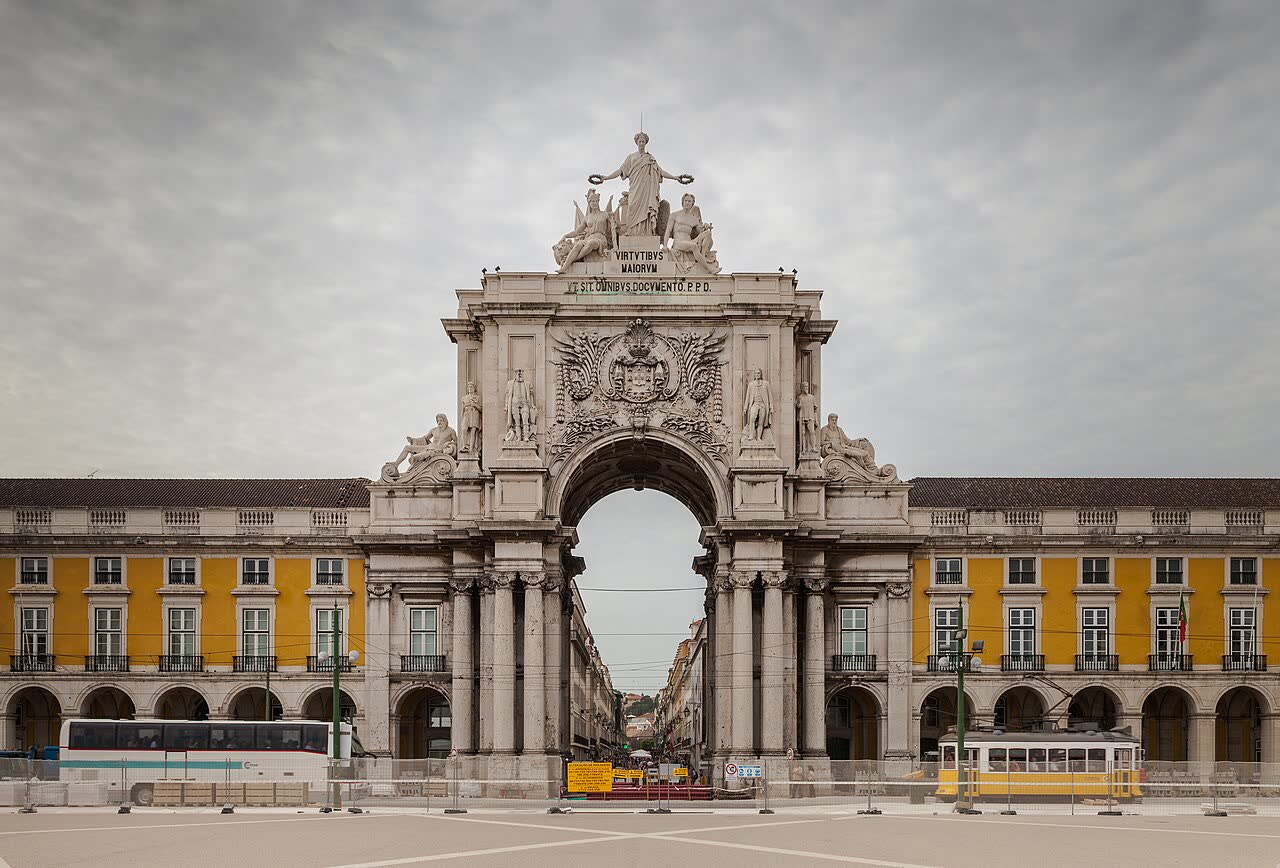
Quick answer: start at Praça do Comércio, climb the Rua Augusta Arch (€5) for the view, then walk up Rua Augusta to Rossio and Praça da Figueira. Add the Lisbon Story Centre (€8) or MUDE, and a ginjinha by Rossio. Allow half a day. The Santa Justa Lift is closed.

Why go: a city rebuilt to a plan
On 1 November 1755 an earthquake, a tsunami and fire wrecked the lower town. The king’s chief minister, later the Marquês de Pombal, had it rebuilt as one of Europe’s first planned city centres. Eugénio dos Santos and Carlos Mardel drew a grid of straight streets and matching buildings, framed with the gaiola pombalina, a wooden lattice designed to flex in an earthquake.
Many streets are named after old trades: Rua do Ouro (gold), Rua da Prata (silver) and Rua dos Douradores (gilders). The Baixa Pombalina has been on Portugal’s tentative list for UNESCO World Heritage since 2004.
Praça do Comércio and the river
Locals still call it Terreiro do Paço, after the royal palace that stood here until 1755. Yellow arcades line three sides and the fourth opens onto the Tagus. The equestrian statue of King José I dates from 1775, and King Carlos I was assassinated here in 1908. The marble steps of the Cais das Colunas, once the landing stage for royal visitors, are a favourite sunset spot.
Under the arcades, Martinho da Arcada has served customers since 1782; the poet Fernando Pessoa was a regular.
The Rua Augusta Arch
Finished in 1875, the triumphal arch has a lift to the Clock Room, which tells its story, then 74 steps to a roof terrace with 360-degree views. Tickets cost €5, free for under-5s and with the Lisboa Card. It’s open daily from 10am to 7pm (last entry 6:30pm). Allow about 30 minutes.
Lisbon Story Centre
Also under the arcades, this multimedia exhibition runs from Lisbon’s founding myths to the earthquake and the rebuilding. It’s open daily from 10am to 7pm (last entry 5:45pm). Adults pay €8, students and over-65s €6, ages 6 to 15 €4 and families of four €20, and it’s free with the Lisboa Card. Allow about an hour.
Rua Augusta and the side streets
The pedestrian street through the arch runs straight up to Rossio, past chain stores and street performers. The parallel streets are calmer.
- MUDE: the Design and Fashion Museum, in a former bank at the river end, reopened in July 2024 after eight years of works, with a rooftop terrace. Adults pay €13, or €15 with the temporary shows; under-12s go free and the Lisboa Card gives 50% off. Closed on Mondays. See Lisbon museums.
- Rua dos Correeiros: beneath a bank building, the NARC archaeological site shows about 2,500 years of history, including Roman fish-salting tanks. Free guided visits, usually Monday to Saturday; book ahead.
- Rua da Prata and Rua dos Douradores: quieter, with old shopfronts and cheaper lunch places. Fernando Pessoa set his Book of Disquiet in an office on Rua dos Douradores.
- Rua do Ouro: the iron Santa Justa Lift stands just off it. It has been closed since September 2025, so admire it from below. See the Santa Justa Lift.
Rossio and Praça da Figueira
Rossio, officially Praça D. Pedro IV, has been Lisbon’s main square since the Middle Ages. Its black and white wave pavement, the “wide sea”, was first laid in 1848–49, one of the earliest examples of Portuguese calçada. The column topped by King Pedro IV dates from 1870.
On the north side, the Teatro Nacional D. Maria II (1846), built where the Inquisition had its palace, reopened in September 2026 after restoration. Just west, Rossio station has a neo-Manueline facade from 1890 with two horseshoe-shaped entrances, and trains to Sintra leave from here. See Lisbon to Sintra.
Just east, on Largo de São Domingos, A Ginjinha has poured sour cherry liqueur from a tiny counter since 1840, for about €1.50 to €2 a glass. See our ginjinha guide.
Praça da Figueira, next door, held the All Saints Royal Hospital until 1755 and a covered market until 1949. Today it has a statue of King João I and the stops for trams 12E and 15E and bus 737 to the castle.
Shops with history
Lisbon’s Lojas com História plaques mark old family businesses. Most close on Sundays.
- Confeitaria Nacional: on Praça da Figueira since 1829, still run by the founding family, and the shop that says it brought bolo rei to Portugal. See the best pastel de nata.
- Manteigaria Silva: a deli by Rossio, trading since 1890, with salt cod on one side and hams, cheeses and wine on the other.
- Luvaria Ulisses: a tiny glove shop on Rua do Carmo, just uphill, open since 1925, where you’re fitted at the counter.
Where to eat
Skip places with photo menus and staff calling you in on Rua Augusta and around Rossio. Walk a street or two away and look for a handwritten prato do dia (dish of the day). Bread and olives on the table are charged only if you eat them. Three reliable choices:
- Marisqueira Uma: a small place on Rua dos Sapateiros, open since 1988 and known for its soupy seafood rice (arroz de marisco). Arrive at opening time.
- As Bifanas do Afonso: a hatch on Rua da Madalena serving garlicky pork rolls for a few euros. Usually closed Sundays; bring cash.
- Zé dos Cornos: a family-run tasca near Praça da Figueira, with grilled pork ribs at shared tables. Mainly lunch, cash only.
More ideas: the best restaurants in Lisbon.
Is the Baixa a good base?
For a first visit, yes. It’s the flattest part of the old centre, close to Alfama, Chiado and the river, with three metro stations and trains to Sintra. The downsides are crowds and noise on Rua Augusta, summer prices and men offering fake “hashish”. Many old buildings are walk-ups, so ask about lifts and pick a side street. Expect the €4 nightly tourist tax.
Since February 2026, shops and bars can’t sell alcohol to take outside after 11pm Sunday to Thursday, or after midnight on Fridays and Saturdays. See where to stay in Lisbon.
Getting there and around
- Metro: Terreiro do Paço (blue line) for the river, Baixa-Chiado (blue and green) for the middle, and Rossio (green) or Restauradores (blue) for the top.
- Trams: 15E runs to Belém, 12E loops round the castle hill, and 28 crosses the Baixa between Alfama and Chiado. See the trams guide.
- Uphill: with the Santa Justa Lift and Glória funicular closed, ride the free escalators inside Baixa-Chiado station or minibus 51E from Rossio to Largo do Carmo.
Book ahead: a guided walk brings the earthquake and the rebuild to life, and most historic-centre tours cover the Baixa. See Lisbon walking tours, or compare tip-based and paid options in our walking tours guide.
FAQ
How much does it cost to go up the Rua Augusta Arch?
€5, or free with the Lisboa Card and for under-5s. It’s open daily from 10am to 7pm, with a lift most of the way and 74 steps at the end.
Is the Santa Justa Lift open?
No. It has been closed since September 2025, with no official reopening date. Use the Baixa-Chiado metro escalators to reach Chiado.
Is the Baixa a good area to stay in Lisbon?
Yes, especially on a first visit. It’s central, flat and close to the metro, but Rua Augusta is busy, so choose a side street.
How long do you need in the Baixa?
Half a day covers Praça do Comércio, the arch, Rua Augusta and Rossio. Add a couple of hours for the Lisbon Story Centre or MUDE.
More: Lisbon in one day and things to do in Lisbon.
See also: Alfama, Chiado and Bairro Alto, Avenida da Liberdade, what to eat in Lisbon and the Carmo Convent.
Some links in this guide are affiliate or referral links (GetYourGuide, Booking.com, Discover Cars, Welcome Pickups, Airalo, Yesim, Saily, Tiqets, Radical Storage, EKTA, AirHelp, Uber). If you book or sign up through them we may earn a small commission or ride credit at no extra cost to you. It helps keep our groups and this site free.
Still got questions?
Ask 305,000+ travellers and locals in our free Facebook groups.