
Trip guides / Lisbon
Carmo Convent, Lisbon: The Roofless Church in Chiado
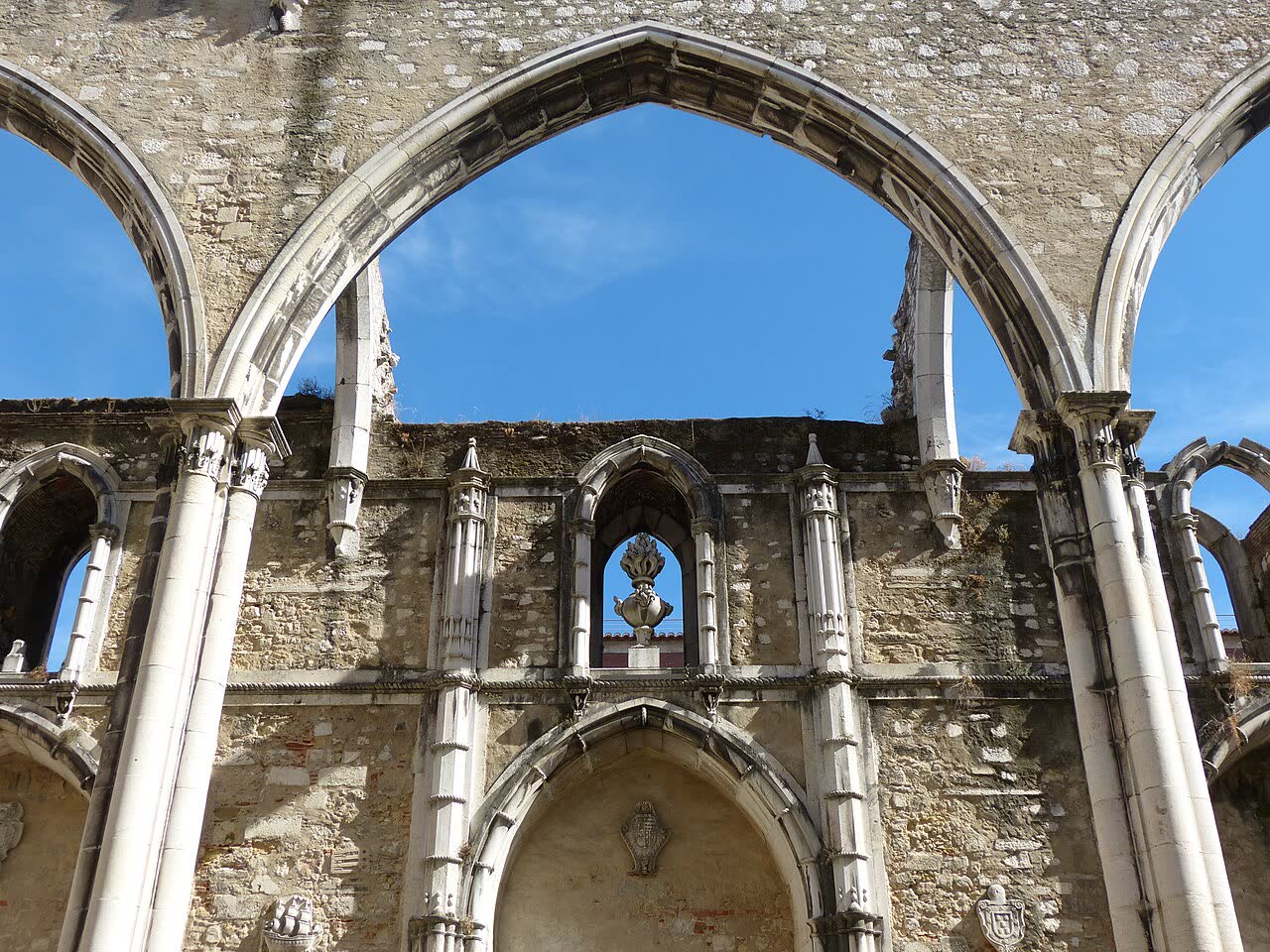
The Carmo Convent is one of Lisbon’s most striking sights: a Gothic church that lost its roof in the 1755 earthquake and never got it back. You walk down a nave open to the sky to a small archaeology museum. Outside is Largo do Carmo, where the 1974 revolution came to a head.
Quick answer: the Carmo Convent (Convento do Carmo) is a roofless 14th-century church in Chiado, home to the Carmo Archaeological Museum. It’s usually open Monday to Saturday, 10am to 6pm (7pm from May to October) and closed on Sundays. Adults pay €7; children aged 14 and under go free. Allow about 45 minutes. The Santa Justa lift is closed, so take the metro to Baixa-Chiado or walk up from Rossio.

A short history
The convent was founded in 1389 by Nuno Álvares Pereira, the Constable of Portugal who beat the Castilian army at Aljubarrota in 1385. He paid for the church himself, and in 1423 he joined the Carmelite order here as Friar Nuno of Saint Mary. He died in the convent on 1 November 1431 and was made a saint in 2009.
On 1 November 1755, exactly 324 years later, the great earthquake struck. The quake and the fires that followed wrecked the church, destroying almost all its art, a library of about 5,000 books and Nuno’s tomb.
Why it was never rebuilt
Rebuilding began in 1756 and carried on, partly in neo-Gothic style, under Queen Maria I. Then in 1834 Portugal abolished its religious orders and the work stopped, leaving the nave and transept roofless. Romantic 19th-century taste admired ruins, so it stayed that way, while the convent’s living quarters became barracks.
In 1864 the Association of Portuguese Archaeologists (founded in 1863 under an earlier name) opened Portugal’s first museum of art and archaeology in the ruins, to rescue carvings and tombs from the convents closed in 1834. It still runs it.
What you see
The open-air nave
You enter through the carved Gothic west door into three aisles of pillars and pointed arches, with nothing above them but sky. There’s no shelter in the nave, so bring a hat in summer and an umbrella when it rains.
The Carmo Archaeological Museum
The museum fills the old chancel and the side chapels at the east end, five small rooms in all. It’s an eclectic collection. Look out for:
- The tomb of King Fernando I: the richly carved tomb of the king who ruled from 1367 to 1383, brought from Santarém.
- The mummies: pre-Columbian mummies from Peru, including one of a boy.
- Prehistoric finds: objects from the Copper Age hillfort of Vila Nova de São Pedro, near Azambuja, from around 3000 BC.
- Carved stone: a 4th-century Roman sarcophagus showing the Muses, Roman inscriptions, a 9th or 10th-century pillar decorated with griffins and a 13th-century bust thought to be King Afonso Henriques.
- Azulejos: 18th-century blue and white tile panels showing scenes from Christ’s Passion.
There are ramps, a platform lift and an accessible toilet for visitors with reduced mobility.
Tickets and opening hours
- Hours: usually Monday to Saturday, 10am to 6pm from November to April and 10am to 7pm from May to October, in Easter week and from 26 December to 6 January. Last entry is 20 minutes before closing.
- Closed: every Sunday, plus 1 January, 1 May and 25 December.
- Adults: €7.
- Reduced (€5): students and over-65s with ID, Portuguese residents and Lisboa Card holders.
- Free: children aged 14 and under with an adult, and disabled visitors with a certificate, plus one companion.
- Paying: the desk takes cash, cards and MB Way.
Check the museum’s website (museuarqueologicodocarmo.pt) before you go. On a Sunday, try Chiado’s MNAC art museum instead. See Lisbon museums.
Largo do Carmo and 25 April 1974
The square outside is one of Lisbon’s prettiest, shaded by jacaranda trees that turn purple in late spring. In the middle stands the Chafariz do Carmo, a fountain built in 1771 to bring water from the Águas Livres aqueduct. A kiosk has outdoor tables.
It’s also where the dictatorship ended. The old convent buildings beside the church are a barracks of the GNR, the national guard, and on 25 April 1974 the prime minister, Marcello Caetano, took refuge there. Troops led by Captain Salgueiro Maia surrounded the square from about midday as crowds watched. After shots at the façade and hours of talks, Caetano handed power to General António de Spínola and left that evening in an armoured car.
A round marble plaque in the paving, laid by the city in 1992, honours Salgueiro Maia. In 2023 and 2024 the GNR opened the barracks for free visits around 25 April, so check if it’s on during your trip. See Portugal’s history for travellers.
Getting there
- Metro: Baixa-Chiado (blue and green lines). The Chiado exit’s long escalators bring you up to Largo do Chiado, about 5 minutes’ walk from Largo do Carmo.
- On foot from Rossio: short but steep. The Calçada do Carmo starts beside Rossio station and climbs to the square in 5 to 10 minutes.
- The Santa Justa lift: it used to drop you beside the convent, but it has been closed since the September 2025 funicular accident.
- Tram and bus: tram 28 stops in Chiado and bus 758 serves the area. The 51E minibus, the Glória funicular’s stand-in, loops from Restauradores to Largo do Carmo (check it’s running). See the Lisbon public transport guide.
Nearby
- Chiado cafés: A Brasileira, open since 1905, and the custard tarts at Manteigaria are a few minutes away. See Chiado and Bairro Alto.
- São Roque Church: about five minutes uphill, with gilded side chapels behind a plain front. Free to enter. See Lisbon churches.
- São Pedro de Alcântara: a garden viewpoint looking across the Baixa to the castle, under 10 minutes’ walk away. See the best Lisbon viewpoints.
- Bairro Alto: quiet by day, packed with bars at night. Since February 2026, bars can’t sell drinks to take outside after 11pm Sunday to Thursday, or after midnight on Fridays and Saturdays.
Evening events in the ruins
The ruins sometimes host concerts and shows. A free choir festival filled the nave on 6 June 2026, and in several past years (most recently 2024) a night show, Lisbon Under Stars, projected the city’s history onto the arches. Check the museum’s social media for what’s on.
FAQ
Is the Carmo Convent open on Sundays?
No. It’s closed every Sunday, as well as on 1 January, 1 May and 25 December.
How much does the Carmo Convent cost?
Adults pay €7, and students, over-65s and Lisboa Card holders pay €5. Children aged 14 and under go free with an adult.
Why does the Carmo Convent have no roof?
The 1755 earthquake wrecked it, and rebuilding stopped for good in 1834, when Portugal abolished its religious orders.
How do you get to the Carmo Convent without the Santa Justa lift?
Take the metro to Baixa-Chiado, use the Chiado exit and walk about 5 minutes. From Rossio, walk up the steep Calçada do Carmo.
More: things to do in Lisbon and Lisbon museums.
See also: Chiado and Bairro Alto, Lisbon churches, the best Lisbon viewpoints, Portugal’s history for travellers, the Lisbon public transport guide and the Santa Justa Lift.
Prices and details change, so please double-check before you travel. Spotted something out of date? Tell us in the groups.
Still got questions?
Ask 305,000+ travellers and locals in our free Facebook groups.