
Trip guides / Lisbon
National Pantheon, Lisbon: Tickets, Terrace and Tips
The National Pantheon is the big white dome you see above Alfama from the river. The old church of Santa Engrácia holds the tombs of Portuguese greats such as the fado singer Amália Rodrigues and the footballer Eusébio, and its terrace has one of Lisbon’s best views.
Quick answer: open Tuesday to Sunday, 10am to 5pm (6pm from April to September), closed on Mondays. Adults pay €10, under-12s go free with an adult, and the Lisboa Card gets you in free. Allow about an hour, including the terrace. On a Tuesday or Saturday, the Feira da Ladra flea market is right outside.

Santa Engrácia: the church that took centuries
The first church here was begun around 1570 for the Infanta (Princess) Maria. In 1630 thieves stole the consecrated hosts, and a young man, Simão Pires de Solis, was executed for it in 1631. Legend says he was only there to meet a novice from the Santa Clara convent next door, and swore the works would never be finished, as surely as he was innocent.
A storm brought the chapel down in 1681, and in 1682 work began on today’s Baroque church, designed by the royal architect João Antunes. When he died in 1712 it was still unfinished, and in 1910 the army was using it as a shoe factory. A 1916 law chose it as the National Pantheon, but works only began in 1960, and the dome was finished for the opening on 7 December 1966. No wonder “obras de Santa Engrácia” is still Portuguese slang for a job that never ends.
Who is buried here
Burial here is a national honour voted by parliament. The four tomb rooms in the corners hold:
- Amália Rodrigues: the queen of fado, moved here in 2001. See fado in Lisbon.
- Eusébio: Benfica’s and Portugal’s great footballer, moved here in 2015.
- Writers: Almeida Garrett, João de Deus, Guerra Junqueiro, Aquilino Ribeiro, the poet Sophia de Mello Breyner Andresen (2014) and Eça de Queiroz, the latest arrival, in January 2025.
- Presidents: Manuel de Arriaga, Teófilo Braga, Sidónio Pais and Óscar Carmona, plus the opposition leader Humberto Delgado.
- Aristides de Sousa Mendes: the consul who saved thousands of refugees in 1940 has a plaque, but is buried in his home village.
In the nave, six cenotaphs (memorial tombs with no body) honour Luís de Camões, Vasco da Gama, Henry the Navigator, Pedro Álvares Cabral, Afonso de Albuquerque and Nuno Álvares Pereira. Camões and Vasco da Gama really lie in the Jerónimos Monastery, and Henry the Navigator at Batalha.
Inside: marble and the dome
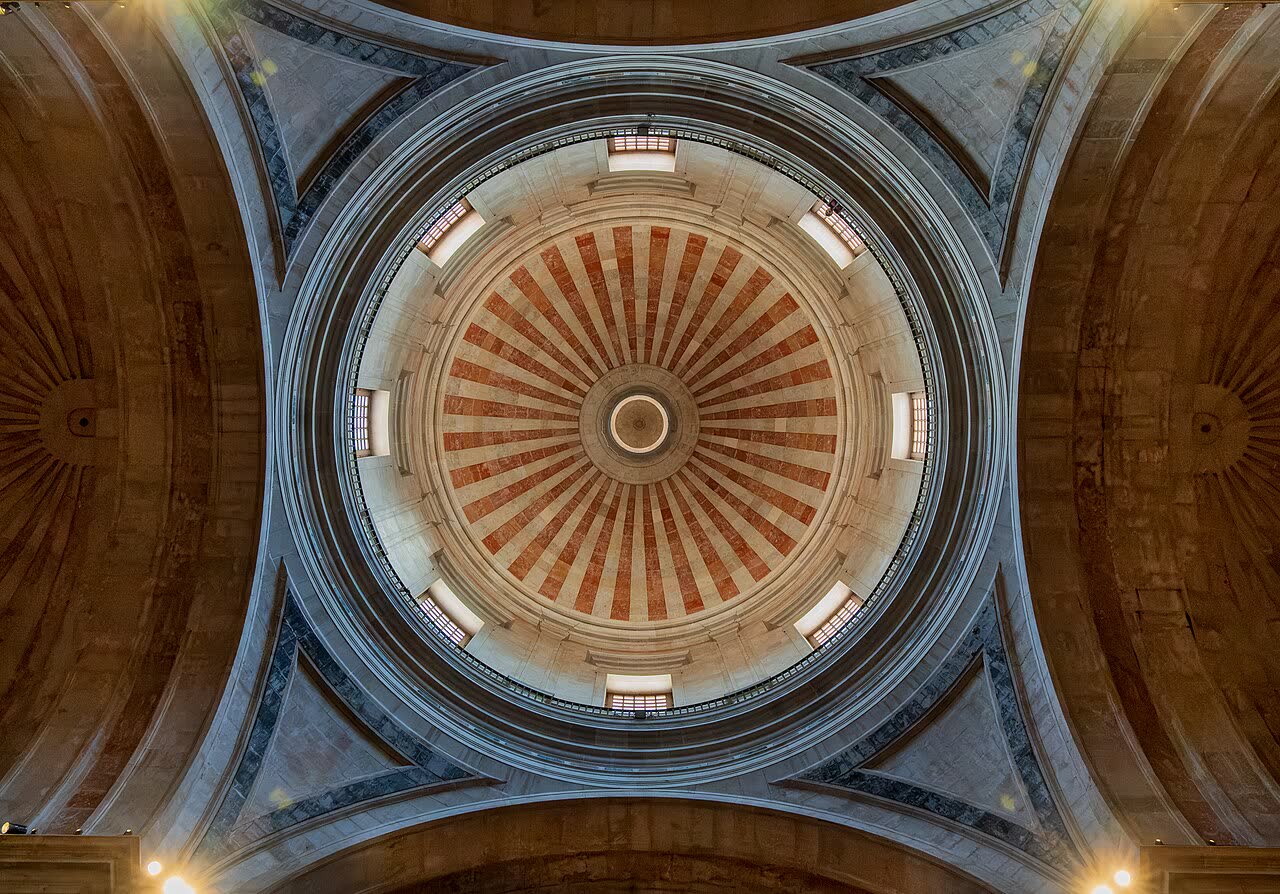
The church is a Greek cross, with four equal arms and a tower at each corner. Inside, floors and walls are covered in patterned marble of many colours, and the dome rises about 80 metres. From the upper level you look down over the nave and the 18th-century organ.
Climbing to the terrace
The terrace is the highlight, and it’s included in the ticket. It sits about 40 metres up and you reach it by stairs, so take your time. From the top you look over the Alfama rooftops to São Jorge Castle, along the Tagus and across to São Vicente de Fora. Bring a hat in summer. For more views, see the best Lisbon viewpoints.
Tickets and prices (2026)
- Adults: €10.
- Ages 13 to 24 and over-65s: half price, €5.
- Families: 50% off for at least one adult with a child.
- Free: under-12s with an adult, and disabled visitors plus one companion.
- Lisboa Card: free entry. See is the Lisboa Card worth it?
Pay at the desk (cash, Visa or Multibanco) or online on the official Museus e Monumentos de Portugal ticket site.
Free days: none for visitors from abroad. The old free Sundays for residents ended in 2024: anyone living in Portugal now gets 52 free days a year at state monuments, on days of their choice.
Opening hours
- October to March: Tuesday to Sunday, 10am to 5pm (last entry 4:40pm).
- April to September: Tuesday to Sunday, 10am to 6pm (last entry 5:40pm).
- Closed: Mondays, 1 January, Easter Sunday, 1 May, 13 June (Lisbon’s Santo António holiday) and 25 December.
Accessibility
The official site lists step-free access only on the ground floor: the nave and the tomb rooms. The upper level and terrace involve stairs, so if steps are a problem, ask at the desk before you pay.
Getting there
- Tram 28: get off at Voz do Operário and walk a few minutes downhill. It’s running its full route in October 2026, but check Carris for changes. See the trams guide.
- Bus 734: Martim Moniz to Santa Apólonia via Graça, stopping on Campo de Santa Clara.
- Metro or train: Santa Apólonia (blue metro line and CP station), then about ten minutes’ walk uphill.
- From Graça: a downhill walk. See Graça.
Combine it with the Feira da Ladra and São Vicente
The Pantheon stands at the end of Campo de Santa Clara, home of the Feira da Ladra every Tuesday and Saturday (officially 9am to 6pm). Browse the stalls first, as many pack up from early afternoon, then visit the Pantheon. Walk back up the square to São Vicente de Fora, with its tiled cloisters and royal tombs, and finish with lunch in Graça or Alfama. Allow about three hours.
Prefer a guide? Compare guided Alfama walking tours, but check whether entry is included: the Pantheon ticket is only €10 at the door.
FAQ
How much does the National Pantheon in Lisbon cost?
€10 for adults in 2026, half price for ages 13 to 24 and over-65s, and free for under-12s with an adult or with the Lisboa Card.
Is the National Pantheon open on Mondays?
No. It’s closed every Monday and on a few holidays, including 13 June. Otherwise it opens 10am to 5pm, or 6pm from April to September.
Can you go up to the terrace?
Yes. It’s included in the ticket, about 40 metres up, and reached by stairs.
Who is buried in the National Pantheon?
Amália Rodrigues, Eusébio, Eça de Queiroz, Sophia de Mello Breyner Andresen and four presidents, among others. Vasco da Gama and Camões only have memorials here.
More: Lisbon’s churches and Lisbon’s museums.
See also: São Vicente de Fora, the Feira da Ladra, Graça and free things to do in Lisbon.
Some links in this guide are affiliate or referral links (GetYourGuide, Booking.com, Discover Cars, Welcome Pickups, Airalo, Yesim, Saily, Tiqets, Radical Storage, EKTA, AirHelp, Uber). If you book or sign up through them we may earn a small commission or ride credit at no extra cost to you. It helps keep our groups and this site free.
Still got questions?
Ask 305,000+ travellers and locals in our free Facebook groups.