
Trip guides / Lisbon
Sao Vicente de Fora Monastery: Tiles, Tombs and Views
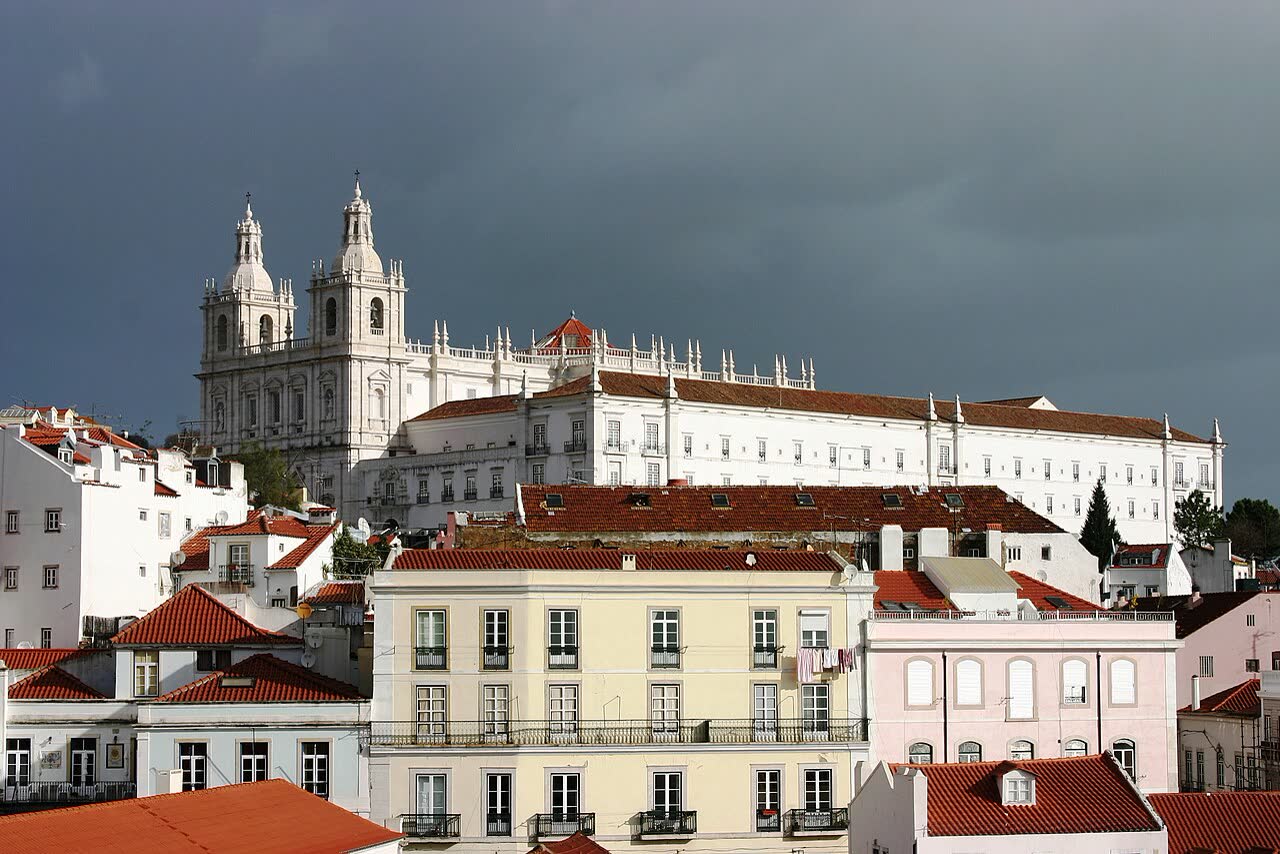
São Vicente de Fora is one of Lisbon’s biggest monasteries and one of its least crowded sights. Behind the twin-towered façade on the edge of Alfama are tiled cloisters, the tombs of Portugal’s last royal family and a roof with river views, with the Feira da Ladra and the National Pantheon right next door.
Quick answer: open every day, 10am to 7pm from June to October and 10am to 6pm from November to May (last entry an hour before closing). Tickets are €8 for adults, €4 under 25, €6 over 65, free under 12. Allow about an hour for the La Fontaine tiles, the Braganza royal pantheon and the roof. Take tram 28 to Voz Operário.

Why go
The monastery says it keeps about 100,000 baroque tiles in their original place, one of the largest such collections in the world. It’s also open on Mondays, when many state-run monuments are shut.
A short history
During the siege of Lisbon in 1147, King Afonso Henriques vowed to build a monastery to St Vincent if he took the city. It was founded that year outside the walls, hence “de Fora” (outside), and Augustinian canons stayed until 1834. Philip II of Spain (Philip I of Portugal) ordered a complete rebuild, begun in 1582 and credited to Juan de Herrera, Filippo Terzi and Baltasar Álvares. The church was inaugurated in 1629, one of Portugal’s first big Mannerist buildings, and the marble and tiles came later. Today it’s the seat of the Patriarchate of Lisbon.
What you see inside
The tiled cloisters
In 1737 the walls of the two cloisters were covered with 65 tile panels from Valentim de Almeida’s workshop. The scenes aren’t religious: hunting, fishing, dancing and games, copied from French engravings. The visit also takes in a 12th-century cistern.
The La Fontaine fables
The most famous tiles are a set of 38 panels, each illustrating one of La Fontaine’s fables, a collection the monastery calls unique in the world. With the National Tile Museum closed for restoration, this is one of the best places to see azulejos in Lisbon in 2026. See azulejos in Portugal.
The sacristy
An 18th-century room credited to the architect Luís Nunes Tinoco, with walls of coloured inlaid marble and Brazilian jacaranda cabinets. Under the floor are 12th-century tombs thought to hold knights of the Second Crusade.
The royal and patriarchs’ pantheons
João IV, the first Braganza king, chose São Vicente for his family’s tombs, and in 1854 Fernando II moved the royal pantheon into the monks’ old refectory. Almost the whole dynasty lies here, including Maria II, Carlos I and his son Luís Filipe (both killed in the 1908 regicide), Manuel II, the last king, and Catherine of Braganza, wife of Charles II of England. Maria I is a notable exception: she’s in the Estrela Basilica. The old chapter house holds the cardinal-patriarchs of Lisbon.
The roof terrace
The monastery calls its roof one of Lisbon’s secret viewpoints, with a 360-degree view over the Tagus, the white dome of the National Pantheon and Alfama’s rooftops. Expect stairs. It’s far calmer than the busy miradouros: see the best Lisbon viewpoints.
The church
Inside the church, look for the canopy over the high altar, designed by Joaquim Machado de Castro after the 1755 earthquake, and the gilded organ. It’s still a working church, so dress modestly and avoid Mass. The official site lists prices only for the monastery, so ask at the door whether the church alone is free. See Lisbon’s churches.
Tickets and hours (2026)
- Adults: €8 (unchanged since January 2024).
- Discounts: €6 over 65 or with the Lisboa Card (not free), €4 under 25, free under 12. Residents of Portugal go free on the first Sunday of the month.
- Guided tour: ticket plus €4, about 90 minutes, booked ahead.
- Hours: daily, 10am to 7pm (1 June to 31 October) and 10am to 6pm (1 November to 31 May), last entry an hour before closing.
- Closed: 1 January, Good Friday, Easter Sunday, 1 May and 24, 25 and 31 December. No weekly closing day.
Getting there
- Tram 28: from Martim Moniz via Graça to the Voz Operário stop, a short walk away. It was running the full route in October 2026, but check Carris. See the trams guide.
- Bus 734: from Martim Moniz via Graça, but the monastery says it doesn’t serve the area on market days (Tuesdays and Saturdays).
- Graça funicular: reopened on 30 April 2026, from Rua dos Lagares in Mouraria up to the Miradouro da Graça, about ten minutes’ walk away. See Graça.
- On foot: about ten minutes uphill from the Portas do Sol viewpoint in Alfama, or a steep climb from Santa Apólonia metro.
- By car: EMEL car parks on Largo de São Vicente and Campo de Santa Clara, except on market days. See parking in Lisbon.
Combine it with nearby sights
- Feira da Ladra: the flea market fills Campo de Santa Clara, right behind the monastery, every Tuesday and Saturday, officially 9am to 6pm. See the Feira da Ladra.
- The National Pantheon: the domed church of Santa Engrácia is a few minutes’ walk away, with its own roof terrace. It’s closed on Mondays. See the National Pantheon.
Want a guide? The monastery’s own tour (ticket plus €4) is the cheapest way to see the inside with a guide. Alfama walking tours cover the streets around it; check whether entry is included. See Alfama walking tours.
FAQ
Is São Vicente de Fora worth visiting?
Yes, especially if you like tiles or history. For €8 you get tiled cloisters, royal tombs and a roof with river views, usually with far fewer people than the castle.
How much does São Vicente de Fora cost?
€8 for adults in 2026, €6 for over-65s and Lisboa Card holders, €4 for under-25s and free under 12.
Is São Vicente de Fora open on Mondays?
Yes. It opens daily except a few holidays, so it’s a good Monday plan when the National Pantheon is shut.
Who is buried at São Vicente de Fora?
Most of the Braganza dynasty, including João IV, Carlos I, Prince Luís Filipe and Manuel II, the last king, plus the cardinal-patriarchs of Lisbon.
More: Lisbon’s best museums and Lisbon Cathedral.
See also: Instagram spots in Lisbon, Lisbon street art and the Feira da Ladra flea market.
Some links in this guide are affiliate or referral links (GetYourGuide, Booking.com, Discover Cars, Welcome Pickups, Airalo, Yesim, Saily, Tiqets, Radical Storage, EKTA, AirHelp, Uber). If you book or sign up through them we may earn a small commission or ride credit at no extra cost to you. It helps keep our groups and this site free.
Still got questions?
Ask 305,000+ travellers and locals in our free Facebook groups.